This app is still undergoing development, please note.pirouter is a lightweight LLM routing daemon. It speaks the OpenAI Chat
Completions API to your agents and routes each request to the cheapest model
that is likely to handle it well.
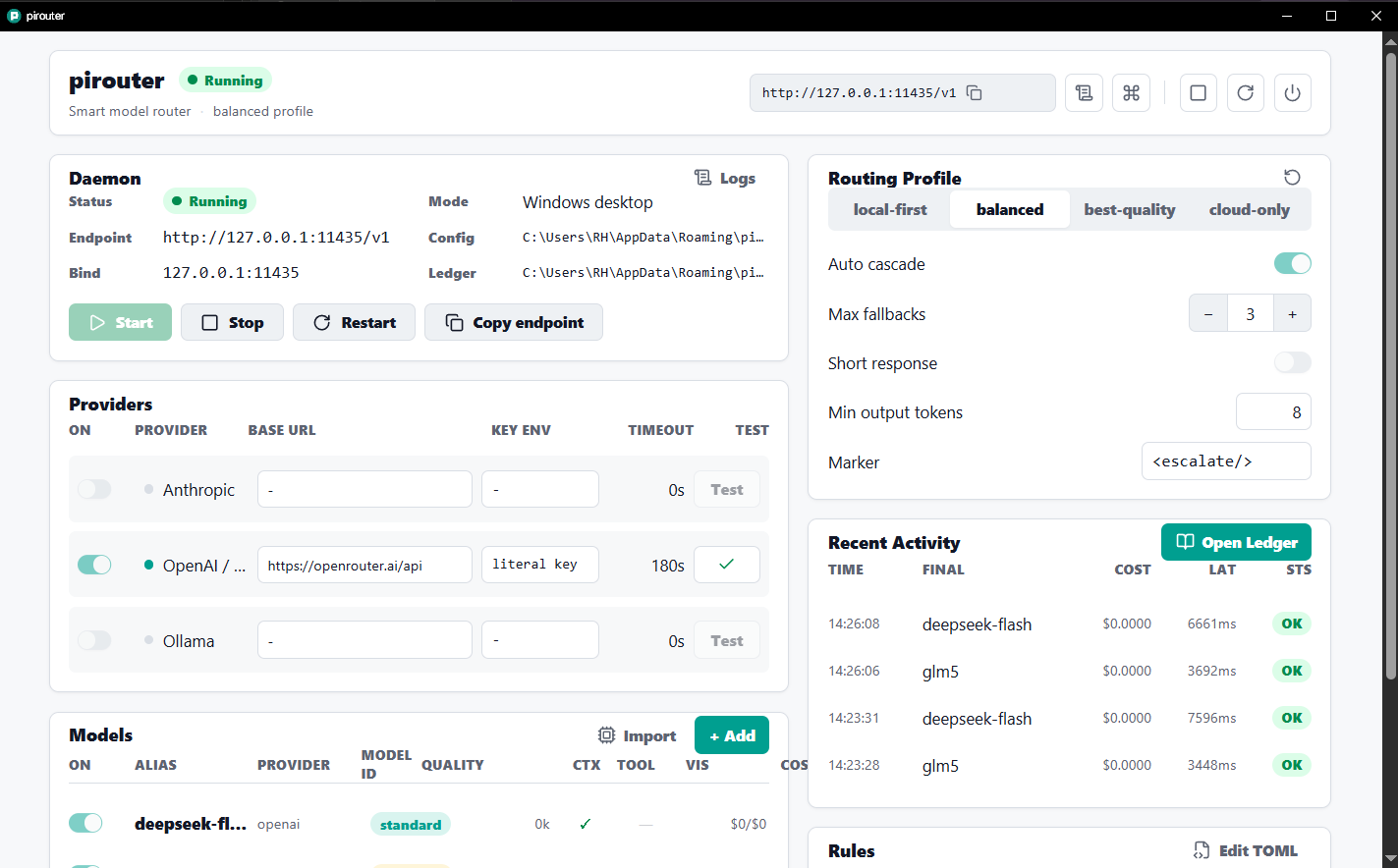
Point tools like Aider, Continue, OpenWebUI, LangChain clients, or your own scripts at one local OpenAI-compatible endpoint. pirouter decides whether the work should go to a local Ollama model, a cheaper cloud model, or a stronger fallback.
- One local endpoint for many providers. OpenAI-compatible clients only
need to change
base_url. - Cost-aware routing. Route easy requests to cheaper/local models and save stronger models for tasks that need them.
- Declarative rules. Keep routing policy in TOML instead of scattering it through prompts and agent code.
- Capability-aware defaults. If no rule matches, pirouter can choose from the model catalog by quality tier, tool support, context window, local/cloud placement, and routing profile.
- Cascade fallback. Escalate from a cheap primary model to stronger models on provider errors, short responses, or explicit escalation markers.
- Observable spend. A SQLite ledger records model attempts, tokens, cost, latency, and escalation path.
- Local-first friendly. Ollama is supported as a first-class provider.
cargo install --git https://github.com/riverho/pirouter --tag v0.1.0git clone https://github.com/riverho/pirouter.git
cd pirouter
cargo install --path .Create a config directory and start from the example config:
mkdir -p ~/.config/pirouter
cp config.example.toml ~/.config/pirouter/config.toml
On Windows PowerShell:
New-Item -ItemType Directory -Force $env:APPDATA\pirouter
Copy-Item config.example.toml $env:APPDATA\pirouter\config.toml
Set provider credentials in your environment. Ollama does not need an API key.
export ANTHROPIC_API_KEY="..."
export OPENAI_API_KEY="..."
PowerShell:
$env:ANTHROPIC_API_KEY = "..."
$env:OPENAI_API_KEY = "..."
For local models, install Ollama and pull a model referenced by your config:
ollama pull llama3.2:3b
ollama pull qwen2.5-coder:7bValidate config:
pirouter check-config
pirouter models
pirouter route --prompt "debug this SQL migration"
Start the daemon:
pirouter runBy default pirouter listens on:
http://127.0.0.1:11435/v1
Send an OpenAI-compatible request:
curl http://127.0.0.1:11435/v1/chat/completions \
  -H "content-type: application/json" \
  -d '{
    "model": "auto",
    "messages": [{"role":"user","content":"Hello from pirouter"}]
}'Rules are evaluated top-to-bottom. The first match wins.
[[rules]]
name = "explicit-override"
when = { header = { name = "x-pirouter-route", any_value = true } }
then = { primary = "$header:x-pirouter-route", cascade = [] }

[routing]
profile = "balanced" # local-first | balanced | best-quality | cloud-only
auto_cascade = true
max_policy_fallbacks = 3
Clients can also send a simple difficulty hint:
x-pirouter-difficulty: easy | standard | hard
pirouter stats --hours 24The ledger is stored in the platform data directory unless overridden in config.toml. It is plain SQLite, so you can inspect it with normal SQLite tools.
v0.1.0 includes:
- OpenAI-compatible /v1/chat/completions
- Anthropic, OpenAI, and Ollama provider adapters
- TOML routing rules
- Capability-aware policy router
- Cascade fallback
- SQLite ledger and pirouter stats
- CLI config validation, model listing, and route dry runs
Planned next surfaces include true streaming, a tray app, semantic local routing, MCP control tools, and optional Pi agent integration.
Apache-2.0. See LICENSE.