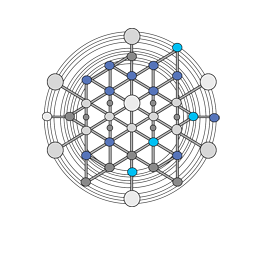






GridForge is a deterministic voxel-world library for building fast spatial systems in games, simulations, tools, and server runtimes.
It gives you the low-level grid infrastructure that many systems end up reinventing: snapped voxel bounds, world-scoped grid registration, conjoined-grid neighbor awareness, scan-cell query overlays, blocker and obstacle state, occupant tracking, and fixed-point spatial math.
The interesting part is the shape of the model. GridForge does not force you into one giant grid, a hand-managed tile map, or a premature hierarchy. It gives you an explicit GridWorld that can own one grid, many conjoined grids, or a streamed set of active grids, while still leaving room for higher-level sector, region, planet, or shard systems above it.
Grid-based systems tend to split into three common approaches:
| Approach | Best fit | Tradeoff |
|---|---|---|
| Single large grid | Small or fixed worlds | Simple, but can become wasteful or awkward to stream |
| Multiple conjoined grids | Large worlds, loaded regions, tiled simulation spaces | More flexible, but needs reliable ownership and neighbor handling |
| Hierarchical grids | Very large or multi-scale worlds | Powerful, but easy to overbuild too early |
GridForge is designed around the most flexible foundation: conjoined grids inside explicit worlds.
That means you can start with a single grid, add neighboring grids as the world grows, remove inactive grids as regions unload, and build hierarchy above the library only when your game or simulation actually needs it.
- Explicit
GridWorldownership for isolated runtime state - Multiple active grids per world, with conjoined boundary neighbor lookup
- Deterministic fixed-point math through
FixedMathSharp - Fast world-space lookup through snapped bounds and a spatial hash
- Scan-cell overlays for efficient radius and occupant queries
- Region coverage through
GridTracer - Blocker and obstacle workflows for world-space blocked areas
- Occupant and partition extension points for gameplay or simulation metadata
- Allocation-conscious internals built on
SwiftCollectionspools and containers - Standard and lean package variants for different dependency needs
dotnet add package GridForgeGridForge targets netstandard2.1 and net8.0.
GridForge is published in two build variants:
| Package | Use when |
|---|---|
GridForge |
You want the default package with MemoryPack, FixedMathSharp, and SwiftCollections. |
GridForge.Lean |
You want the same core voxel-grid API without the direct MemoryPack dependency, using FixedMathSharp.Lean and SwiftCollections.Lean. |
Install the lean package with:
dotnet add package GridForge.LeanSource builds also expose matching configurations:
Releasebuilds the standardGridForgepackage.ReleaseLeanbuilds theGridForge.Leanpackage.
Unity-specific integration lives in the separate GridForge-Unity repository.
using System;
using FixedMathSharp;
using GridForge.Configuration;
using GridForge.Grids;

using GridWorld world = new GridWorld();

GridConfiguration configuration = new GridConfiguration(
    new Vector3d(-10, 0, -10),
    new Vector3d(10, 0, 10),
    scanCellSize: 8);

if (!world.TryAddGrid(configuration, out ushort gridIndex))
    throw new InvalidOperationException("Failed to add grid.");

VoxelGrid grid = world.ActiveGrids[gridIndex];
Vector3d position = new Vector3d(2, 0, -3);

if (world.TryGetGridAndVoxel(position, out VoxelGrid resolvedGrid, out Voxel voxel))
{
    Console.WriteLine($"Grid: {resolvedGrid.GridIndex}");
    Console.WriteLine($"Voxel: {voxel.Index}");
    Console.WriteLine($"World position: {voxel.WorldPosition}");
}
The key mental model is:
- Create a
GridWorld. - Register one or more
VoxelGridinstances fromGridConfiguration. - Resolve world-space positions into grids and voxels.
- Layer scans, blockers, occupants, partitions, or higher-level systems on top.
- Reset or dispose the world when that simulation boundary is done.
The library is built for worlds that grow, stream, and split responsibility cleanly:
- A small game can use one
GridWorldwith oneVoxelGrid. - A streamed world can load and unload grids around the player or active simulation area.
- A server can run multiple isolated
GridWorldinstances in one process. - A larger architecture can put sectors, planets, regions, or hierarchy above GridForge without reworking the voxel layer.
GridForge tracks world-local grid slots, grid spawn tokens, and WorldVoxelIndex values so systems can reason about identity even as grids are removed, reused, or replaced.
| Concept | Role |
|---|---|
GridWorld |
Owns voxel size, spatial hashing, active grids, lifecycle, events, and top-level lookup for one isolated world. |
VoxelGrid |
Owns one grid's snapped bounds, voxels, scan cells, neighbor relationships, obstacle summary state, and versioning. |
Voxel |
Represents one snapped cell with obstacle, occupant, partition, boundary, and cached neighbor state. |
ScanCell |
Groups voxels into query buckets so radius scans can skip empty regions. |
GridTracer |
Converts lines and bounds into covered voxels or scan cells across the active grids in a world. |
BoundsBlocker |
Applies and removes obstacle state over traced world-space bounds. |
IVoxelOccupant |
Represents dynamic entities that can be registered, deregistered, and scanned. |
IVoxelPartition |
Attaches typed voxel-local metadata or behavior directly to a voxel. |
Start with the wiki:
- Wiki Home
- Getting Started
- Core Concepts
- Common Workflows
- Architecture Overview
- Recipes
- FAQ and Troubleshooting
The source for those pages lives in docs/wiki.
dotnet restore GridForge.slnx
dotnet build GridForge.slnx --configuration Debug
dotnet test GridForge.slnx --configuration Debug --no-build
CI validates both Release and ReleaseLean on Ubuntu and Windows.
For benchmark discovery:
dotnet run --project tests/GridForge.Benchmarks/GridForge.Benchmarks.csproj -c Release -- listBenchmarks are especially useful when changing pooling, tracing, grid registration, scan flow, or other allocation-sensitive paths.
See CONTRIBUTING.md for contribution guidelines and workflow details.
When working on core behavior, keep the library deterministic, world-scoped, allocation-conscious, and free of engine-specific assumptions.
For questions, discussions, or general support, join the official Discord community:
For bug reports or feature requests, please open an issue in this repository.
GridForge is licensed under the MIT License. See LICENSE, NOTICE, and COPYRIGHT for details.


