Repository navigation
Read named state sets and states written as values of their sets - #17
Conversation


The verifier now accepts @stateset(name = "phase", value = {...}) and a
state written as a value of its set, phase(this) == open, which it reads
as open(this), and phase(this) != open as !open(this). The parser took
such a from for a condition on every state, so the diagram lost its
transitions.

A comparison of a one-argument function with a state, in either order,
is now that state, and != negates it, wherever the shorthand is read:
from, to, constructors and factories. Conditions keep the form the spec
wrote. Each state machine carries stateSetName, the name given to its
state set, or null when it has none, so a client can label the diagram
with the name the verifier's messages use.

Co-Authored-By: Claude Opus 5.5 <noreply@anthropic.com>

Codex review, round 1
ResponseBoth declined:
No changes in this round. |
open(this) != false is not phase(this) != open: it means open(this), so
its complement drew the transition from the other states. Only a
comparison that is itself a state value is read as its negation.

Co-Authored-By: Claude Opus 5.5 <noreply@anthropic.com>
Codex review, round 2
ResponseFixed in b5a1061: |
Codex review, round 3
|
Clean-code reviewAudit of this PR's diff against the clean-code-principles checklist (
No changes. |


Brings
[liquidjava-fsm#17](liquid-java/liquidjava-fsm#17)
to the extension, for the verifier's named state sets and states written
as values of their sets (liquid-java/liquidjava#498, #510, #511; design
in liquid-java/liquidjava#502).

**Depends on a liquidjava-fsm 0.2.3 release** of liquidjava-fsm#17:
until it is on Maven Central, `server` does not build in CI.

## What changes

- `server/pom.xml`: liquidjava-fsm 0.2.2 → 0.2.3, which reads
`phase(this) == open`, `open == phase(this)` and `phase(this) != open`
in `from`/`to` as the states they name, and reports each diagram's
`stateSetName`.
- `StateMachineDTO`: passes `stateSetName` to the client (the
`liquidjava/fsm` request returns the fsm records, so it gets it as is).
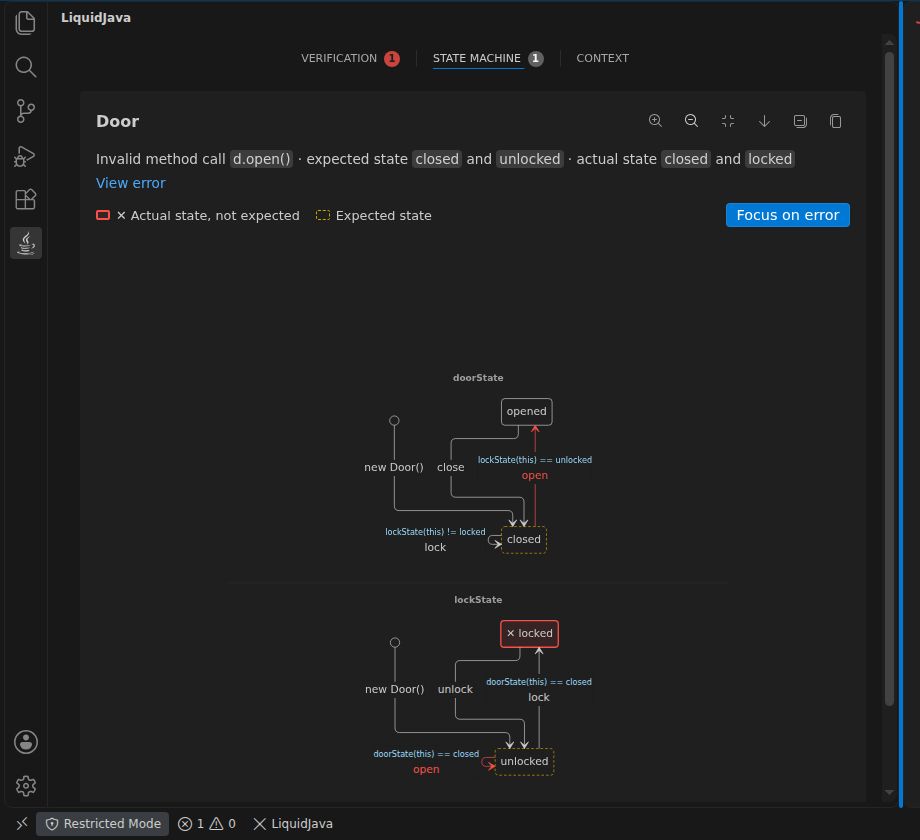
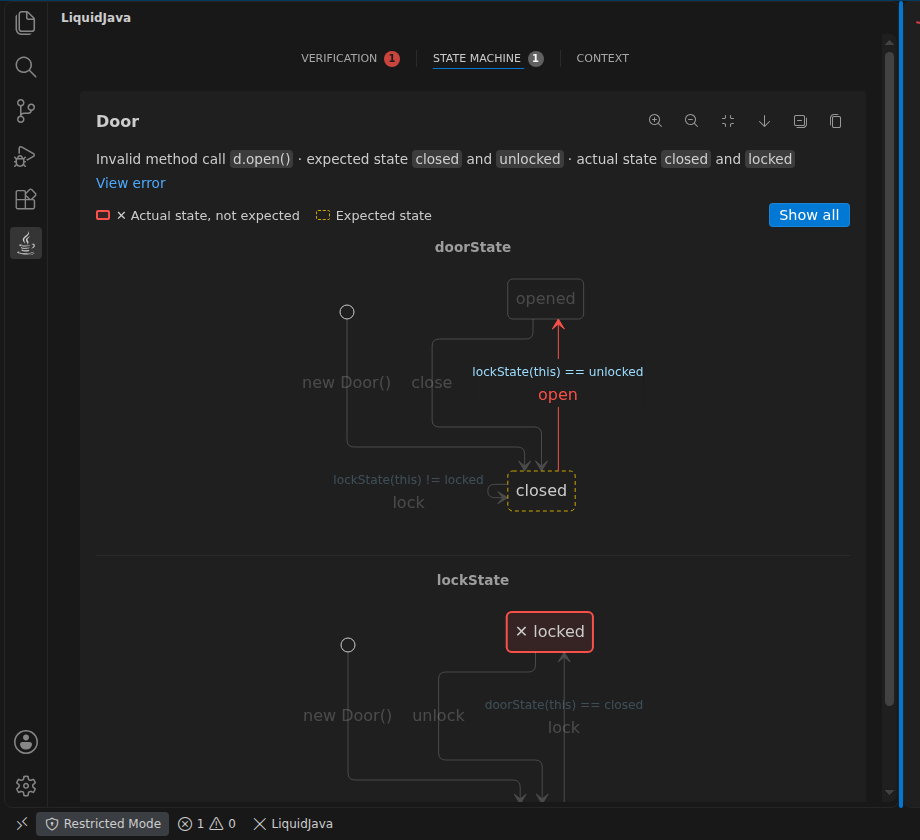
- State Machine view: a named state set's diagram is titled with its
name, also when it is the class's only state set, so it can be matched
with the error message (`doorState(d) == closed`). A state set without a
name keeps its states as the title, as now.

## Checked, no change needed

The verifier sends the same shapes to the IDE as before (`git diff
fbc5e9f6 origin/main`): `StateErrorContext` still names states by their
names, and hints are unchanged. Only the text of a state error's
message, `expected` and `found` changes, to `doorState(d) == closed` for
named sets. The client renders those strings as they come, with the
generic highlighter, and nothing in the client parses state names out of
message text: the diagram marks and the summary line use `errorContext`.
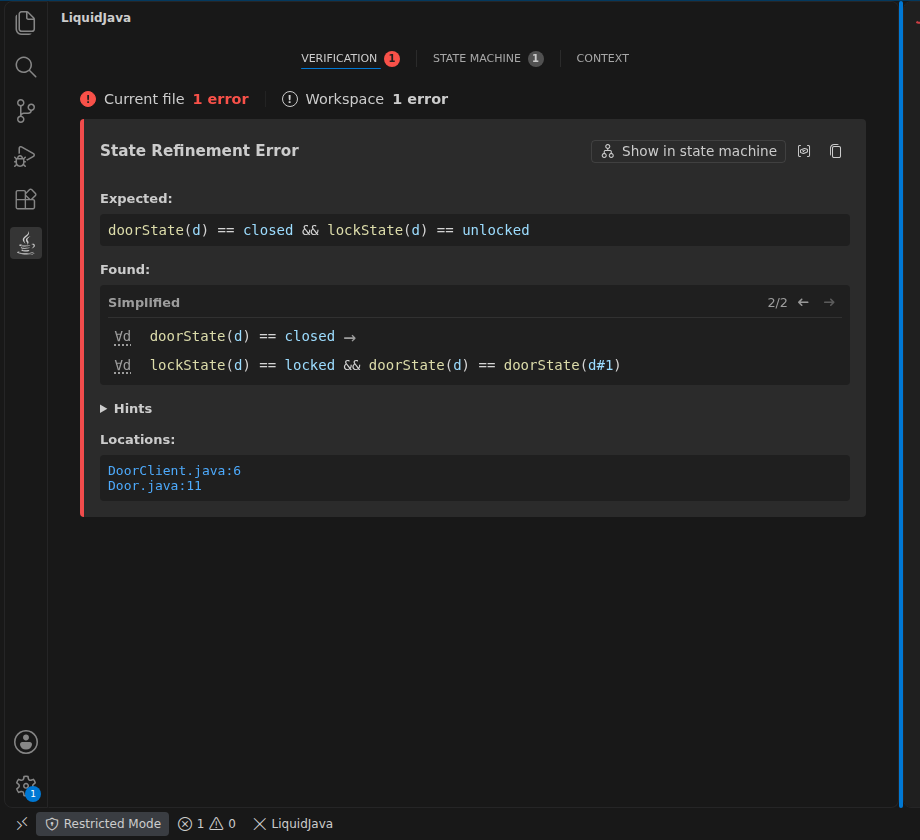
The verification view shows the new form as is (last screenshot).

## Screenshots

Headless VS Code with this branch, liquidjava-fsm#17 installed locally
as 0.2.3 and the verifier built from liquid-java/liquidjava main, on
this spec (`d.lock(); d.open();` as the error):

```java
@stateset(name = "doorState", value = {"closed", "opened"})
@stateset(name = "lockState", value = {"unlocked", "locked"})
public class Door {
    @StateRefinement(to = "doorState(this) == closed && lockState(this) == unlocked")
    public Door() {}
    @StateRefinement(from = "doorState(this) == closed && lockState(this) == unlocked", to = "doorState(this) == opened")
    public void open() {}
    @StateRefinement(from = "doorState(this) == opened", to = "doorState(this) == closed")
    public void close() {}
    @StateRefinement(from = "doorState(this) == closed && lockState(this) != locked", to = "lockState(this) == locked")
    public void lock() {}
    @StateRefinement(from = "lockState(this) == locked", to = "lockState(this) == unlocked")
    public void unlock() {}
}
```

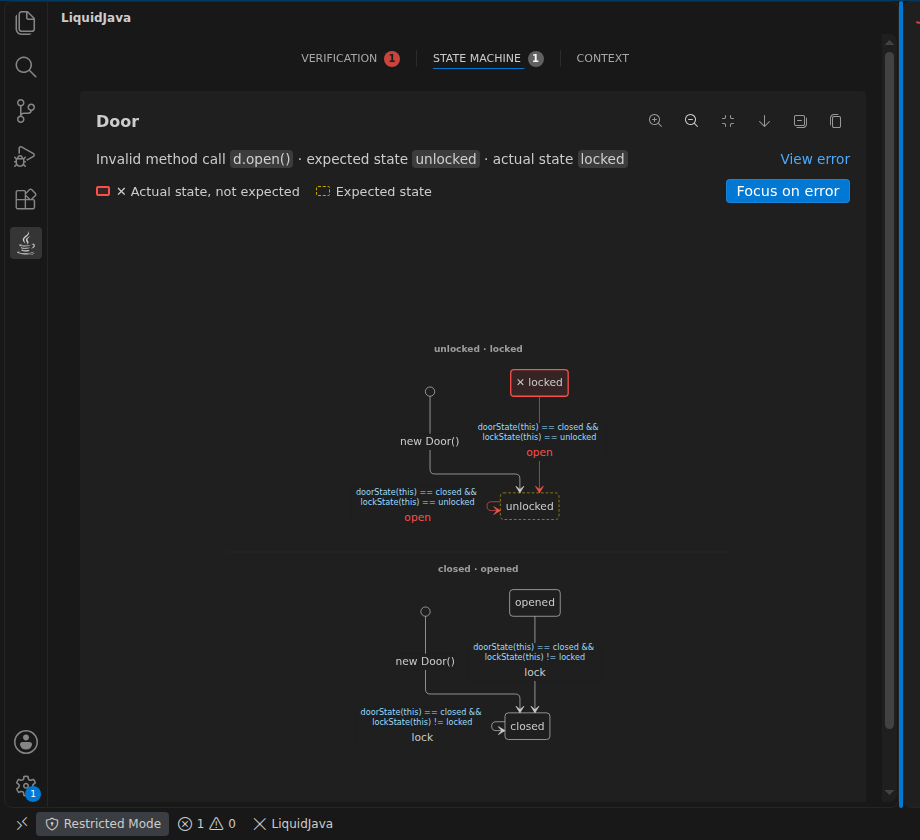
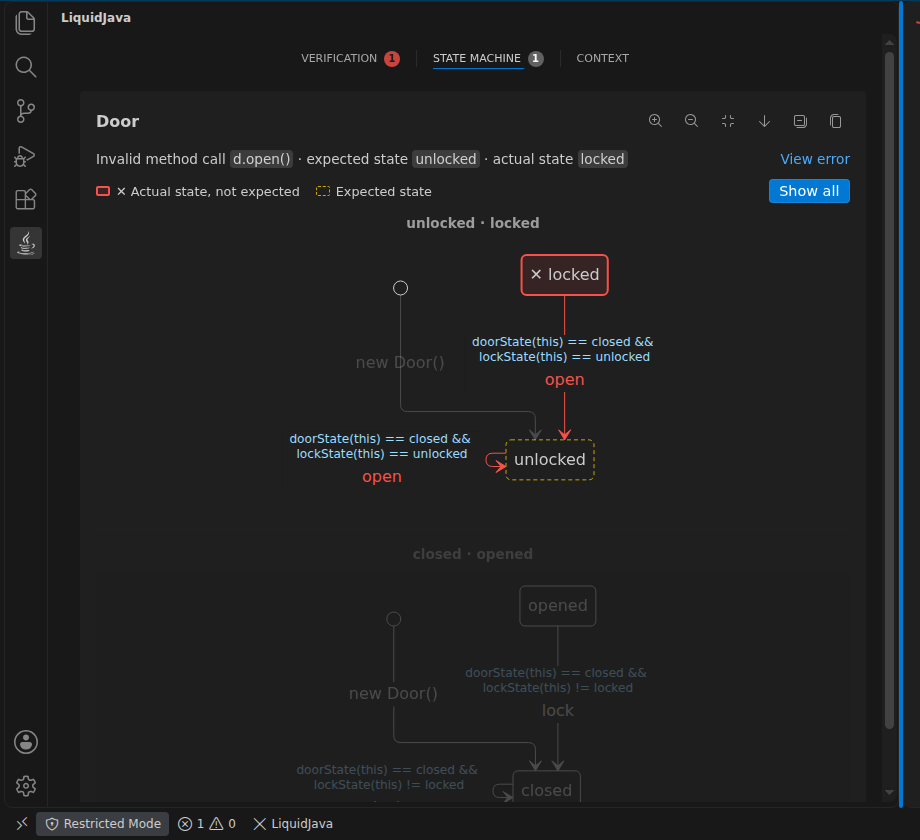
Before (main, fsm 0.2.2), the diagrams are wrong: `open` and `lock` go
from every state with the whole `from` as a condition, `close` and
`unlock` are missing, the summary only names `lockState`, and the titles
are the states. After, the diagrams match the spec, the conditions keep
the form the spec wrote, and the titles are the set names:

| | Before | After |
|---|---|---|
| Show all | <img
src="https://raw.githubusercontent.com/liquid-java/vscode-liquidjava/pr-screenshots/178/before-all.png"
width="380"> | <img
src="https://raw.githubusercontent.com/liquid-java/vscode-liquidjava/pr-screenshots/178/after-all.png"
width="380"> |
| Focus on error | <img
src="https://raw.githubusercontent.com/liquid-java/vscode-liquidjava/pr-screenshots/178/before-focus.png"
width="380"> | <img
src="https://raw.githubusercontent.com/liquid-java/vscode-liquidjava/pr-screenshots/178/after-focus.png"
width="380"> |

The verifier's message for the same error (no change here; shown for
context):

<img
src="https://raw.githubusercontent.com/liquid-java/vscode-liquidjava/pr-screenshots/178/verification.png"
width="380">

## Not in this PR

- The verifier bump: main of liquid-java/liquidjava is not released yet.
When it is, `DiagnosticConverterTest` needs the new
`StateRefinementError` constructor argument (`display`, from #511) and
the `RefinementError` one (`aliases`); the server code itself compiles
against it.
- The walkthrough and README examples stay in the shorthand until the
extension ships a verifier that accepts named sets.

## Tests

- client: `vitest run` 124 passed (one new test, fails without the
change), typecheck and lint clean
- server: `mvn test` 35 passed, against liquidjava-fsm#17 installed as
0.2.3 in an isolated local Maven repository

🤖 Generated with [Claude Code](https://claude.com/claude-code)

Co-authored-by: Claude Opus 5.5 <noreply@anthropic.com>

Follows the verifier's named state sets (liquid-java/liquidjava#498) and states written as values of their sets (liquid-java/liquidjava#510, design in liquid-java/liquidjava#502).
Problem
With the verifier on main, a spec can write
The parser took
open == phase(this)for a condition that holds in any state, soclosewas drawn fromopen,closedandbroken, each with the conditionopen == phase(this).phase(this) != openwent the same way, and a value of another set in atowas kept instead of being left out.Change
getStateNamealso readsset(x) == stateandstate == set(x)(a one-argument function compared with a state) as the state, andgetNegatedreadsa != bas the negation ofa == b, like!. This is the verifier's reading (StateValues.toShorthand), and it applies wherever the shorthand is read:from,to, constructors and factories,this.phase(),phase(),old(this), and generated names such asstate2(this) == unlocked.phase(this) != broken.StateMachinegetsstateSetName: thenameof its@StateSet, or null when it has none. Generated names (state1, ...) are not exposed, since the verifier does not show them in messages either. The old six-argument constructor is kept, as vscode-liquidjava uses it.Unchanged: the parser stays as lax as for the shorthand (it does not check that the function is a state set of the class, nor that a parameter is named like a state); a spec where that matters is rejected by the verifier.
Tests
One fixture,
StateValues.java(a named and an unnamed set,==in both orders,!=,this.phase(),phase(), a generated name, mixed with the shorthand), and one test that fails without the change.mvn testpasses locally (33 tests).Screenshots of the diagrams before and after, in VS Code: liquid-java/vscode-liquidjava#178.
A release is needed before vscode-liquidjava can use
stateSetName(PR to follow there).🤖 Generated with Claude Code