


Loop · Quickstart · Models · Trust · Ladder · Docs · Demo · GitHub
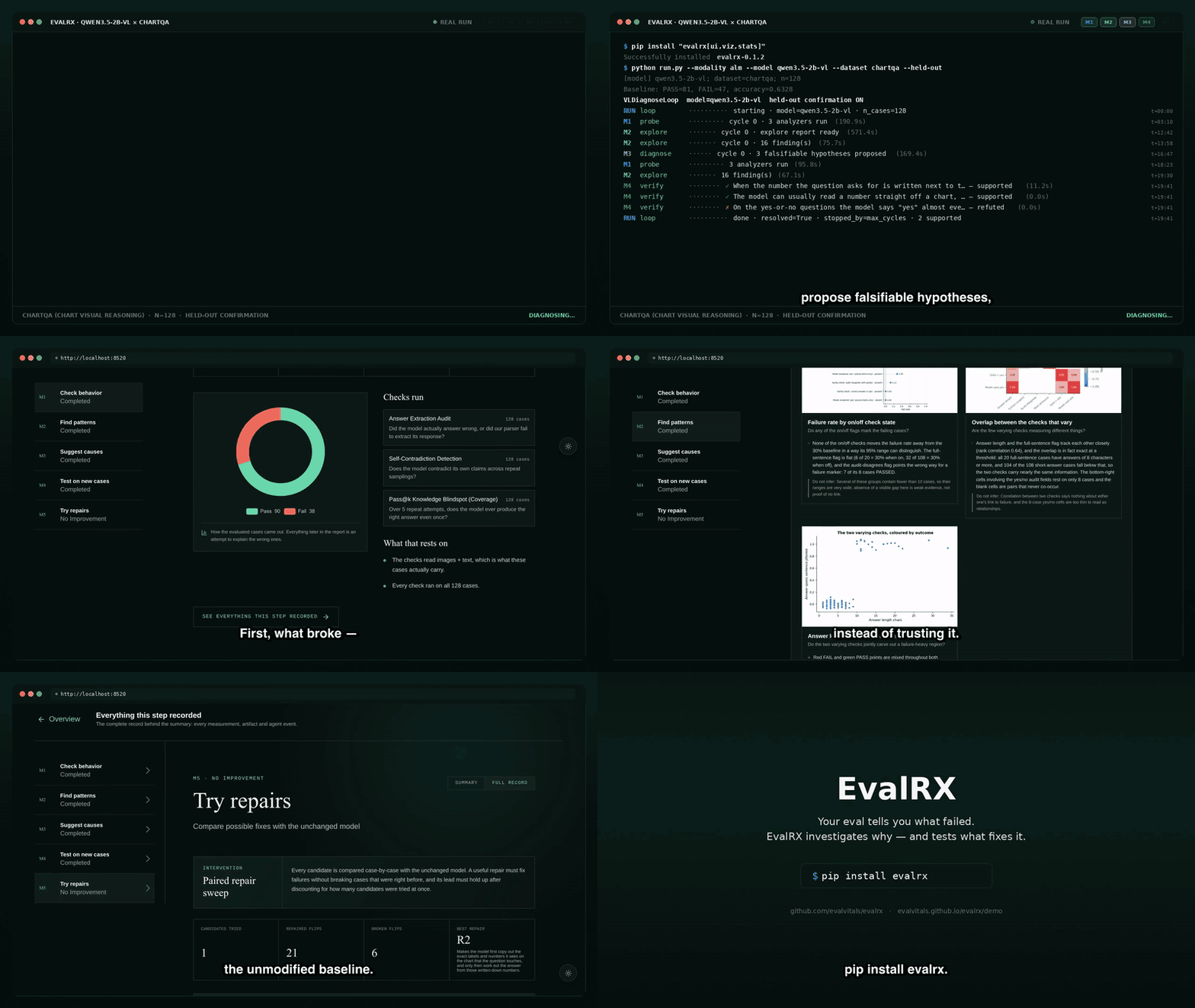
One real run, replayed — 256 MMAU cases, 162 failures, two of three mechanisms upheld on cases the analysis never saw, and an L2 repair that fixed 25 of them while breaking none. 20 minutes of work compressed into 81 seconds; the clock in the gutter is the run's own elapsed time. Browse two full reports → · Watch full video ↗
An eval score is a temperature reading. EvalRX runs the lab: probe a model for failures, form a mechanism, test it on cases the analysis never saw, then climb a repair ladder until a fix beats the unmodified baseline. Only a held-out win updates the model — the healthier model becomes the next subject.
Five stages, no hand-off between them: one agent writes and runs its own analysis code, proposes hypotheses, generates repair candidates, and decides which tier a mechanism needs. A refuted hypothesis returns to probing; a repair that fails moves to the next tier within the ceiling you set. You supply the question and the ceiling — everything between is unattended.

The held-out split is taken before Explore runs, so Verify always scores on rows the analysis never touched. Full-loop quickstart → · Intervention guide →
pip install evalrxPoint it at a file or directory of JSON/JSONL results:
evalrx explore ./results \
  --backend codex \
  -q "What distinguishes failed cases from successful ones?" \
  --serve-report
codex can be replaced with claude_code, opencode, gemini_cli,
kimi_cli, or antigravity — the selected coding-agent CLI must be installed
and authenticated separately. Then open the run, or export a portable file:
evalrx serve evalrx_explore_output                       # local report server
evalrx report evalrx_explore_output --out report.html    # no server, shareable
EvalRX writes an auditable bundle instead of returning only prose:
evalrx_explore_output/
├── exploratory_report.json   # observations, candidate signals, hypotheses
├── records.json              # normalized records used by the analysis
├── figures/  tables/         # rendered charts and analysis-ready tables
└── analysis.py                # the generated code that was actually run
Already have your own analysis code? Use the analyzer toolkit directly, or feed the resulting cases into the full diagnosis loop — EvalRX does not require you to replace your existing eval or observability stack. See the CLI reference for the rest of the command set.
pip install evalrx                # core — no Torch required
pip install "evalrx[api]"         # OpenAI-compatible / API models
pip install "evalrx[local]"       # local Hugging Face models + Torch
pip install "evalrx[finetune]"    # L4 parameter-space repair (LoRA via peft)
pip install "evalrx[viz,stats]"   # plots + inferential statistics
Full extras list (interp, data, observability, ui, cluster,
gemini, contract, all, dev) in pyproject.toml. For
development: pip install -e ".[dev]" then pytest -m "not gpu".
EvalRX currently provides benchmark configurations for the following models.
The names below are the benchmark's --model keys. LLM = text only,
VLM = image + text, and ALM = audio + text; ✓ marks a configured modality.
| Family | Models (--model) |
LLM | VLM | ALM |
|---|---|---|---|---|
| Qwen 3.5 | qwen3.5-2b, qwen3.5-4b, qwen3.5-9b |
✓ | ✓ | — |
| Qwen 3 Omni | qwen3-omni-30b-a3b |
— | — | ✓ |
| Gemma 4 | gemma-4-e2b, gemma-4-e4b, gemma-4-12b |
✓ | ✓ | ✓ |
| Nemotron 3 Nano | nemotron-3-nano-4b |
✓ | — | — |
| Nemotron 3 Nano Omni | nemotron-3-nano-omni-30b-a3b |
— | ✓ | ✓ |
| Gemini 3.x (API) | gemini-3.7-flash, gemini-3.6-flash, gemini-3.5-flash, gemini-3.5-flash-lite, gemini-3.1-flash-lite, gemini-3.1-pro-preview |
✓ | ✓ | ✓ |
| Gemini 2.5 (API) | gemini-2.5-flash, gemini-2.5-flash-lite, gemini-2.5-pro |
✓ | ✓ | ✓ |
Open-weight models use an OpenAI-compatible server (--backend endpoint,
the benchmark default) or run locally with --backend hf_local for access to
model internals. Gemini uses --backend gemini with GEMINI_API_KEY and
requires no local GPU. API backends limit the benchmark's repair ladder to L2.
See examples/benchmark for setup and run commands, datasets, GPU requirements, registered model specs, and per-cell validation status.
Every registered analyzer follows the same call shape:
from evalrx import Capability, compose
from evalrx.analyzers.attention.summary import AttentionAnalyzer

model = compose("qwen2.5-7b-instruct", "hf_local", want={Capability.ATTENTION})
result = AttentionAnalyzer(layer=-1, top_k=5).run(model, "The Eiffel Tower is in")
print(result.summary())
Model identity (ModelSpec) is separate from runtime (Backend), so the same
spec runs through a black-box API or a white-box local backend — only the
available capability set changes. Analyzer Zoo → ·
Architecture guide →
Quickstart · CLI · Exploratory Analysis · Intervention & Verification · Analyzer Zoo · Architecture · Extending EvalRX · Roadmap — all live, searchable, at evalvitals.github.io/evalrx.
More runnable examples, including a full multimodal M1–M5 loop
(deco_hallu) and white-box attention analysis (qwen_attention):
examples/README.md →
An agent can enumerate fifty plausible mechanisms as easily as one — fluency is cheap. What matters is which of them hold on your data.
| How the hypothesis is formed | How it's tested | What the conclusion rests on | |
|---|---|---|---|
| Hire an experimentalist | Intuition, a few candidates at a time | An ablation designed after seeing the data | One researcher's reading, and the ablation they chose to run |
| Let an agent brainstorm | Dozens of candidates at once | A full fine-tune for each one you can afford | Whichever candidates fit the budget |
| EvalRX | Candidates from agent-written EDA | Cross-validated while exploring, decided once on a sealed held-out split | A measured effect, corrected for how many were tried, reproducible from the run log |
Two committed runs back that up — no install required:
| Run | What it shows |
|---|---|
| Attention & hallucination | 606 real VLM cases, 3 checkpoints. Finds attention focus share separates hallucinations at AUC 0.82 — then flags, unprompted, that the verdict is in-sample, that its next-strongest signal is collinear (max VIF 20.7), and that a peaked attention map could be a readout of the answer rather than a cause of it. |
| The confound catch | Catalyst looks significant (ANOVA p = 0.080) until the run notices the groups differ by 21° in temperature. 0 of 4 signals confirmed — the correct answer. |
Held-out splits are taken before exploration, multiplicity is controlled with e-BH, and every fix is compared against the unchanged baseline. A run may end inconclusive — and frequently should.
"Fix it" is not one action — repairs are ordered by how deeply they cut into the model. Escalation is never automatic: the ceiling is yours to set (default L2), and once every candidate at that ceiling fails, the loop recommends raising it rather than climbing on its own.
| Intervention space | Status | |
|---|---|---|
| L1 | Prompt and instruction rewrites | ✅ |
| L2 | Scaffolds around an unchanged model — multi-call, tools, aggregation | ✅ |
| L3a | Read internals — attention-guided cropping, contrastive decoding | ✅ |
| L3b | Write internals — attention reweighting, activation steering | ✅ |
| L4 | Parameter space — build a dataset, fine-tune, re-test | ✅ LoRA on the LLM (fix_internals.py); other recipe shapes recorded, not yet executed |
L3b and L4 only exist for open weights — you cannot modify a forward pass or fine-tune through somebody's API.
EvalRX is an early-stage research toolkit; interfaces may evolve, and some full-loop examples need model weights, a GPU, or an external coding-agent CLI. Bug reports, reproducible failure cases, analyzer contributions, and evaluation integrations are welcome.
This project is licensed under the PolyForm Noncommercial License 1.0.0.
Noncommercial use is permitted under the terms of the license.
Third-party components remain subject to their respective licenses.