SwarmBots is a GPU-vectorized multi-agent reinforcement-learning benchmark for self-assembling modular robots. Each policy controls identical articulated units that can move independently and create or release load-bearing connections during an episode. The collective's physical graph therefore changes as part of the control problem.
The benchmark is built on MuJoCo Warp and exposes vector environments with Gymnasium spaces and reset/step conventions, using PyTorch tensors on the simulation device. Gymnasium wrappers and training libraries that expect NumPy arrays require adaptation. It includes obstacle traversal, partial-observability, climbing, navigation, and payload-transport tasks.
This repository deliberately does not contain a training framework or paper-specific experiment configurations. Bring your own MARL implementation and use the stable registry and evaluation API here.
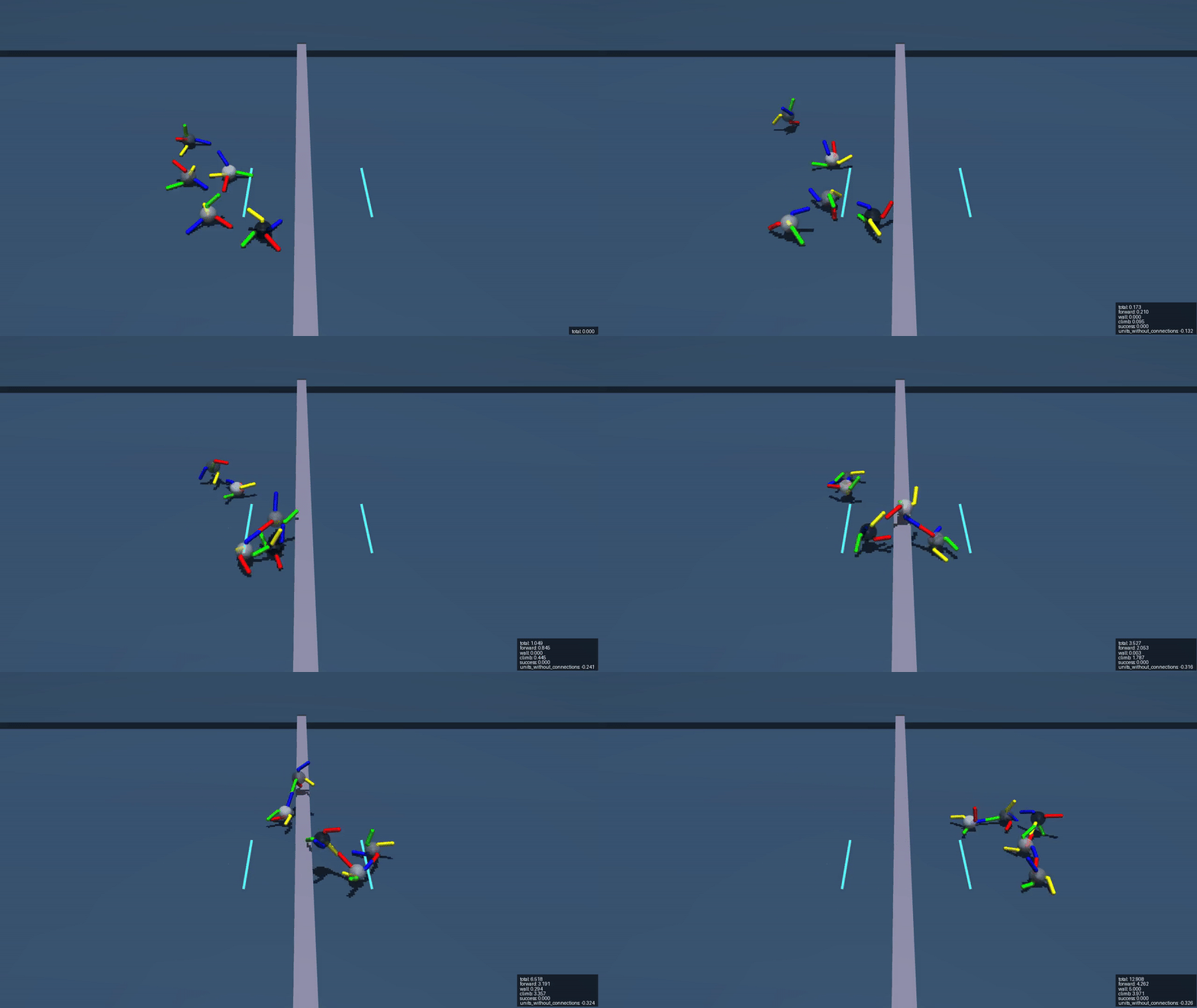
| Wall traversal | Finding a hidden opening |
|---|---|
 |
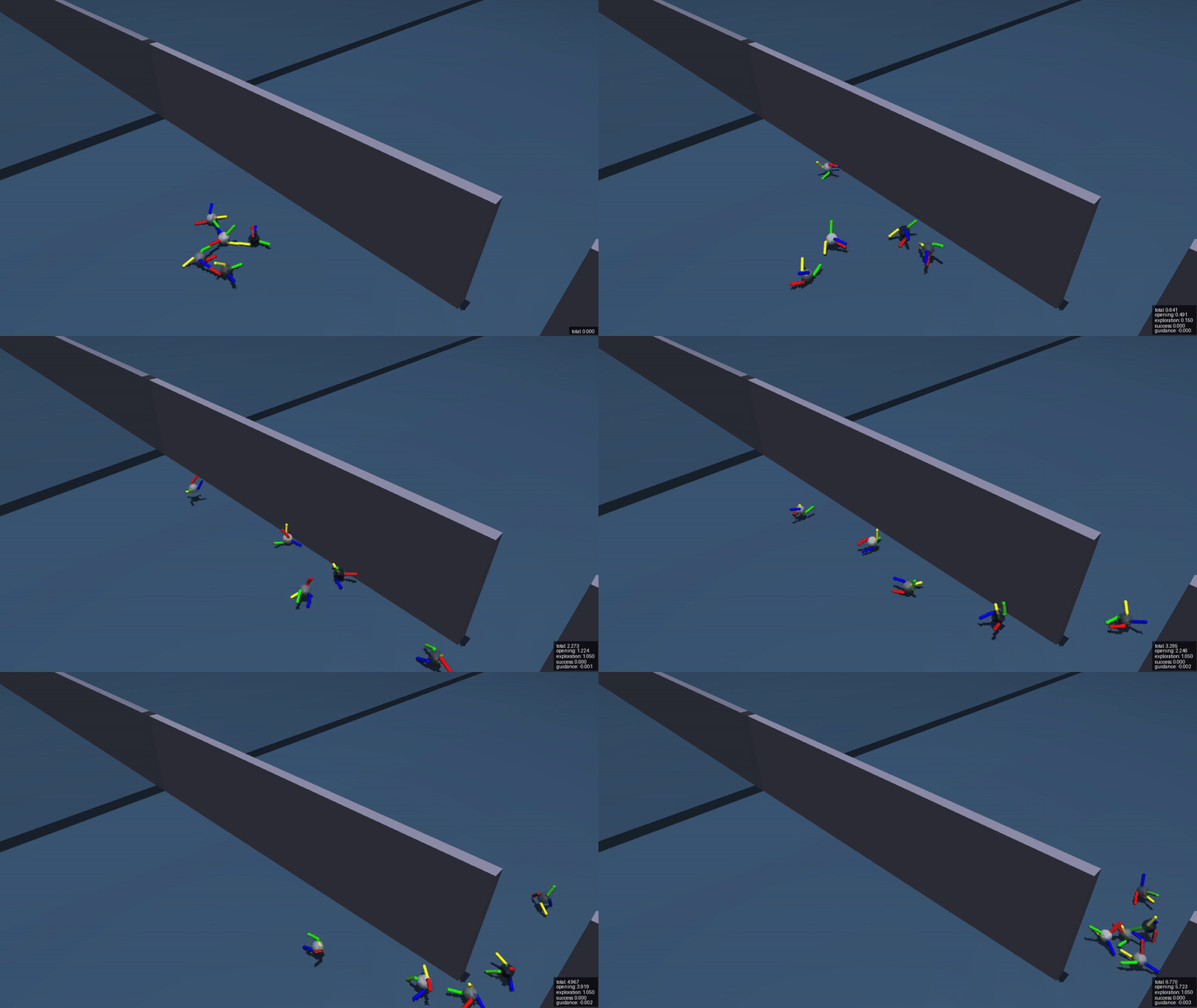 |
These rollouts illustrate the tasks; they are not reference scores for protocol 0.1. See the scenario catalog for task definitions.
Python 3.11 or newer is required. CUDA is strongly recommended; CPU execution exists for development and tests but is not the benchmark's performance target. SwarmBots is currently versioned as an alpha. Once 0.1.0a1 is published to PyPI, install it explicitly with:
uv add "swarm-bots==0.1.0a1"Install from source:
git clone https://github.com/brn-dev/swarm-bots.git
cd swarm-bots
uv sync
The lockfile selects the dependency versions. Follow GPU setup to select a CUDA PyTorch build, configure the compiler, and verify the compiled environment on Linux or Windows. An exact sync may replace a manually installed accelerator build, so keep the index selection in your project configuration.
For contributors:
uv sync --extra devList the registered tasks and run a short smoke test:
.venv/bin/swarmbots list
.venv/bin/swarmbots smoke SwarmBots-WallEasy-v0 --device cuda --num-envs 64
On Windows, use .venv\Scripts\swarmbots.exe. No environment activation is required. For a CPU smoke test, use --device cpu --num-envs 2; CPU simulation is much slower than the intended CUDA path.
Add --compiled to verify PyTorch compilation as well as simulation. The ordinary smoke test uses eager operations; it does not check compiler setup.
Create an environment directly:
import torch
from swarmbots import make_env

env = make_env("SwarmBots-WallEasy-v0", num_envs=256, device="cuda", seed=42)
observations, info = env.reset(seed=42)

actions = {
    "actuators": torch.zeros(env.action_space["actuators"].shape, device=env.device),
    "connectors": torch.zeros(env.action_space["connectors"].shape, device=env.device),
}
observations, rewards, terminations, truncations, info = env.step(actions)
env.close()
The environment uses Gymnasium SAME_STEP autoreset. When a lane ends, the returned observation is already its next reset observation; the terminal observation is in info["final_obs"] and selected by info["_final_obs"].
Explicit resets and autoresets both settle physics before returning observations. The settling interval is outside the episode's control-step budget, so evaluation and training start from the same reset distribution.
Observations are dictionaries of batched tensors:
local_obs: per-agent observations, shaped(worlds, agents, features).global_obs: task information visible to all agents.agent_mask: which padded agent slots are active.hidden_local_varsandhidden_global_vars: privileged state for centralized training or diagnostics. Do not pass these to an evaluated actor.
Actions contain per-agent actuators and connectors tensors. Rewards and done flags are team-level tensors with one value per simulated world.
The built-in evaluate_policy function passes only the non-privileged observation keys to the policy and reports episode returns, lengths, and success rate where defined. Centralized, partially centralized, and decentralized actors are all allowed; actors may combine the permitted observations across agents within each world.
It collects only the first episode from each world. num_episodes must be no greater than num_envs; use additional seeds for more samples. The evaluation example writes raw episodes, settings, runtime versions, and statistics across five seeds to JSON.
- Scenario catalog
- GPU setup and compiled smoke test
- Benchmark and reporting protocol
- Python API, compatibility, and custom policies
- Contributing
- Publishing releases
The API is alpha. Benchmark IDs and protocol versions are explicit so semantic changes can be introduced without silently invalidating results.
The benchmark and its original evaluation are described in:
Dominik Baron. SwarmBots: A GPU-Accelerated Multi-Agent Continuous Control Benchmark with Transformer Baselines. Master's thesis, Johannes Kepler University Linz, 2026.
The complete thesis and reproducibility artifact contains the thesis PDF, training algorithms, experiment configurations, and analysis code. Machine-readable citation metadata is available in CITATION.cff.
SwarmBots is released under the Apache License 2.0.