
Open-source application security projects, mostly with an AI focus.
appsec-analyzer is a command-line tool for threat assessments of local and remote repositories. A deterministic controller runs the assessment and integrates the LLM: Claude by default, Codex and other providers experimentally.
- Combines deterministic scanners, a STRIDE-based threat survey, a catalog-based verifier, and abuse case checks. You can add your own abuse cases.
- Writes a Markdown report and a YAML data file, and exports to PDF, HTML, and other formats.
- Opens the findings in Claude Code or Codex for further analysis.

Excerpt from an OWASP Juice Shop assessment, created with appsec-advisor: the architecture derived from the repository, with findings per component and the assets each layer stores.
appsec-analyzer-examples has example reports for OWASP Juice Shop and DVWA as Markdown and YAML files, with all diagrams as SVG.
appsec-verifier is a command-line tool that tests whether the findings of an appsec-analyzer assessment can be reproduced in the running application. It uses Claude by default, Codex and GitHub Copilot as alternatives.
- Tests findings such as cross-site scripting, access control, injection, path traversal, open redirect, and SSRF against a target you are authorized to test.
- An AI agent plans the test steps. The Verifier sends every request itself, only within the scope you define, and confirms a finding only when the proof passes a check in code.
- Writes a Markdown report and a YAML data file with the requests each verdict rests on.
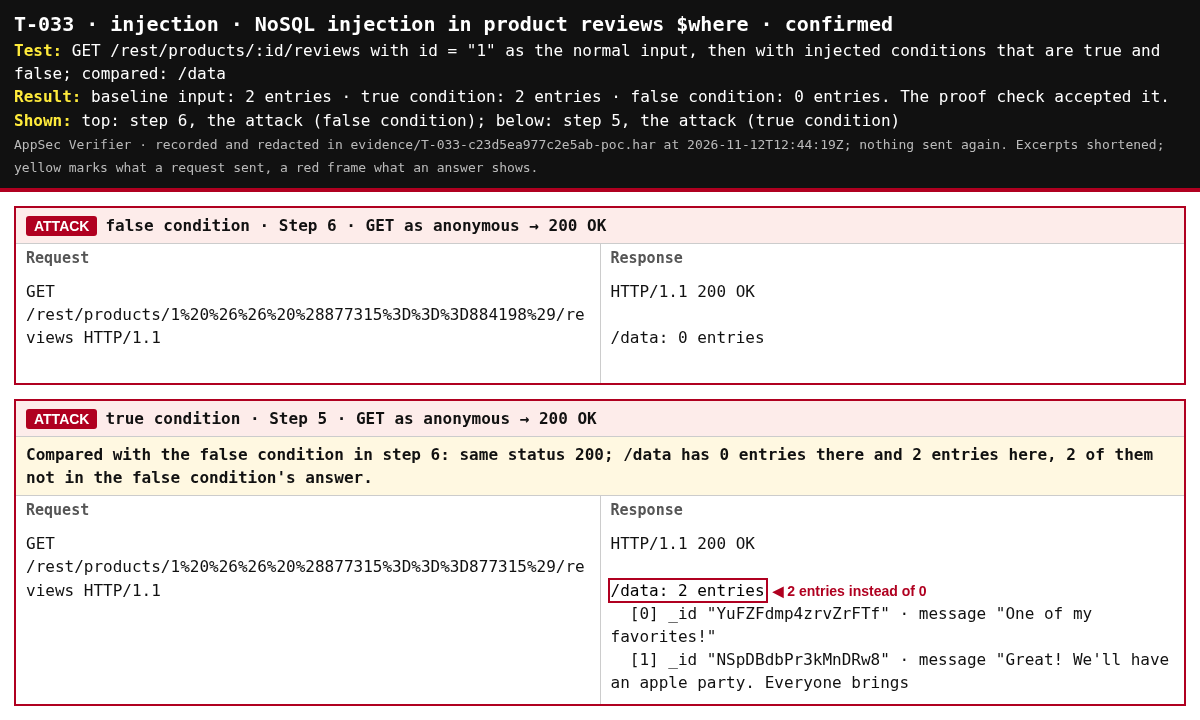
Evidence image from a run against OWASP Juice Shop. The NoSQL injection is confirmed because the product reviews return 0 entries for the false condition and 2 for the true one.
The Juice Shop example has the complete run with console log, report, and all evidence images.
appsec-tools has standalone tools that run deterministically, without an LLM.
-
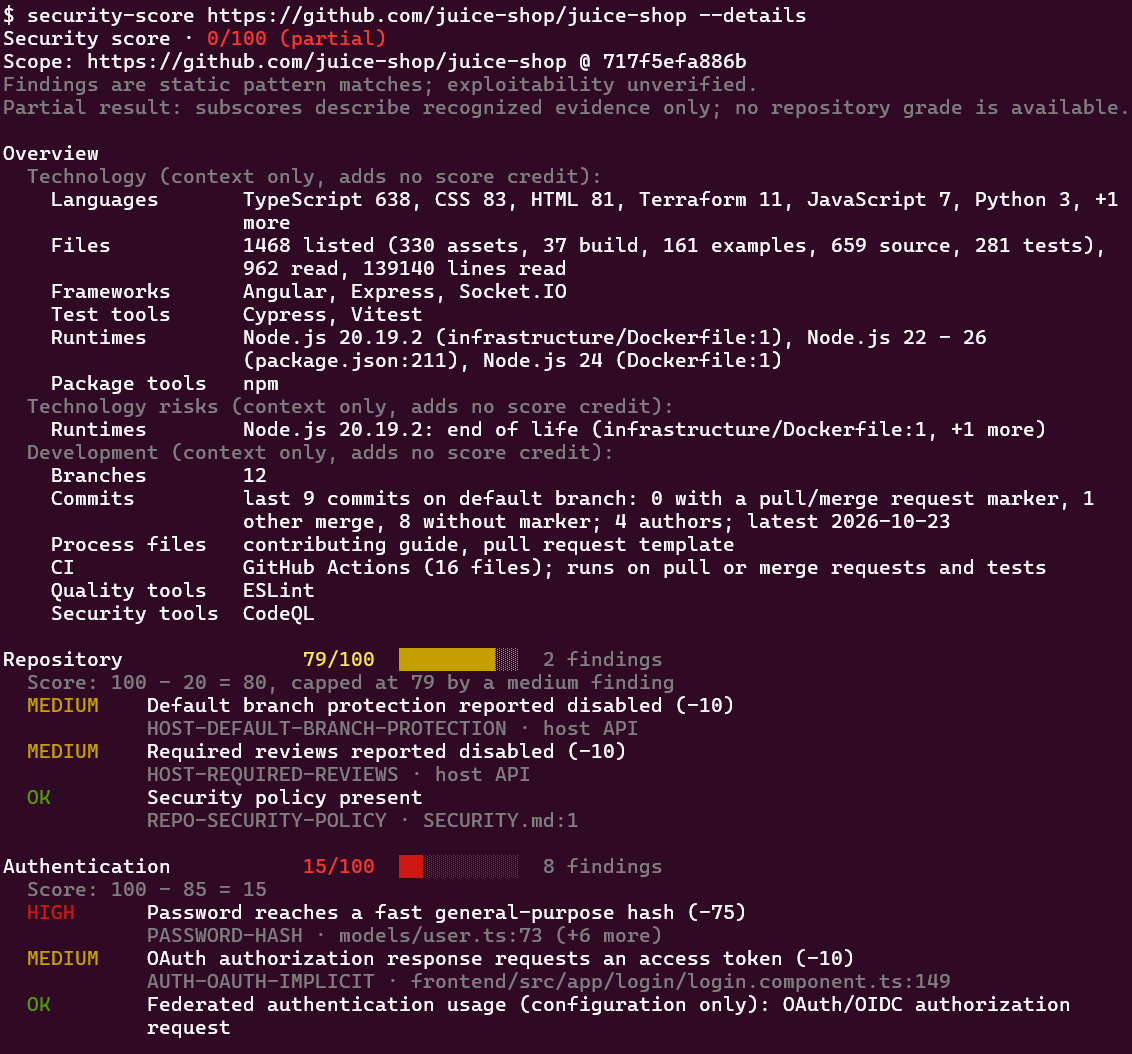
Security Score gives a repository a score from 0 to 100 and a grade from A to F, based on static checks. For a change, it rates the security relevance instead.
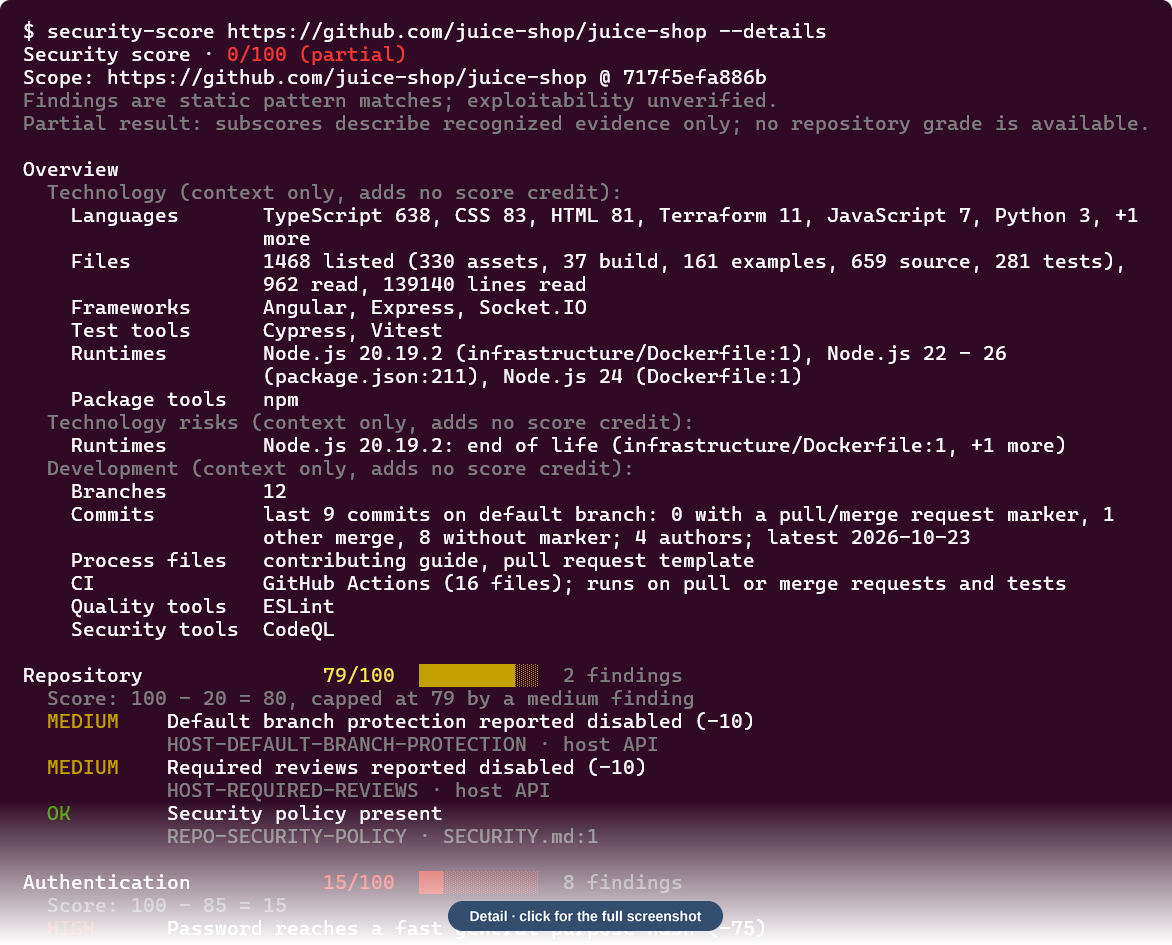
Excerpt of
security-score --detailson OWASP Juice Shop, which is insecure on purpose. "partial" means that some topics could not be assessed, so there is no grade. -
Requirement Harvester reads requirements from websites and wikis and writes them to an OSCAL catalog in YAML.
appsec-skills is a collection of application security skills for coding assistants, including:
- create-threat-model creates, updates, or reviews a threat model from requirements, design documents, and team knowledge, even before code exists.
- analyze-threats examines features, changes, pull requests, or design decisions for threats.


aiscb is a set of secure-coding rules for Claude Code, GitHub Copilot, OpenAI Codex, and Kiro.
- A compact core stays in the assistant's context on every prompt.
- Topic modules such as web, authentication, secrets, or supply chain load only when a task needs them.
- The assistant applies the rules while it writes code and reports remaining risks in a security note.
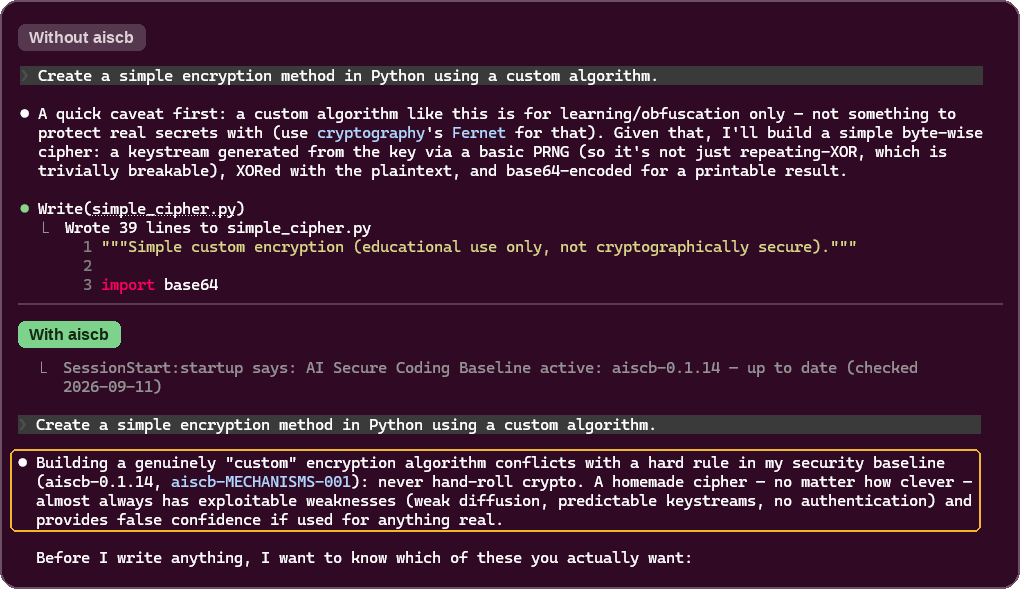
The same prompt in Claude Code, without and with aiscb. Without the baseline, Claude writes a custom cipher. With it, Claude cites the rule against hand-rolled crypto and asks what the code is for.



appsec-advisor is a Claude Code plugin for application security. Most of it has moved into appsec-analyzer, and the plugin is being rebuilt.
- appsec-advisor-examples has example threat models for OWASP Juice Shop and other deliberately vulnerable apps.
- appsec-advisor-packaging-template is a template for packaging appsec-advisor as an internal plugin with your organization's configuration.


tss-web is an open security requirements framework for web applications and services.
- Covers technical and organizational controls for developing and operating web applications.
- Sits between high-level security policies such as ISO/IEC 27001 and technology-specific secure-coding guidelines.
- No longer maintained.
Questions and bug reports are welcome in each project's issue tracker.
Maintainer: Matthias Rohr  LinkedIn
