





Mechanical engineering student · Spacecraft deployment, engines and systems software
BTech, Symbiosis Institute of Technology, Pune · 2023–2027
I like problems that survive the first calculation. My main project is VOLLEY, an investigation into controlled spacecraft departure from a retained orbital host. It began with a mechanism. The work since has been about finding out whether the mission earns that mechanism.
Explore VOLLEY · Explore BOLLEY · Engineering record · Contact
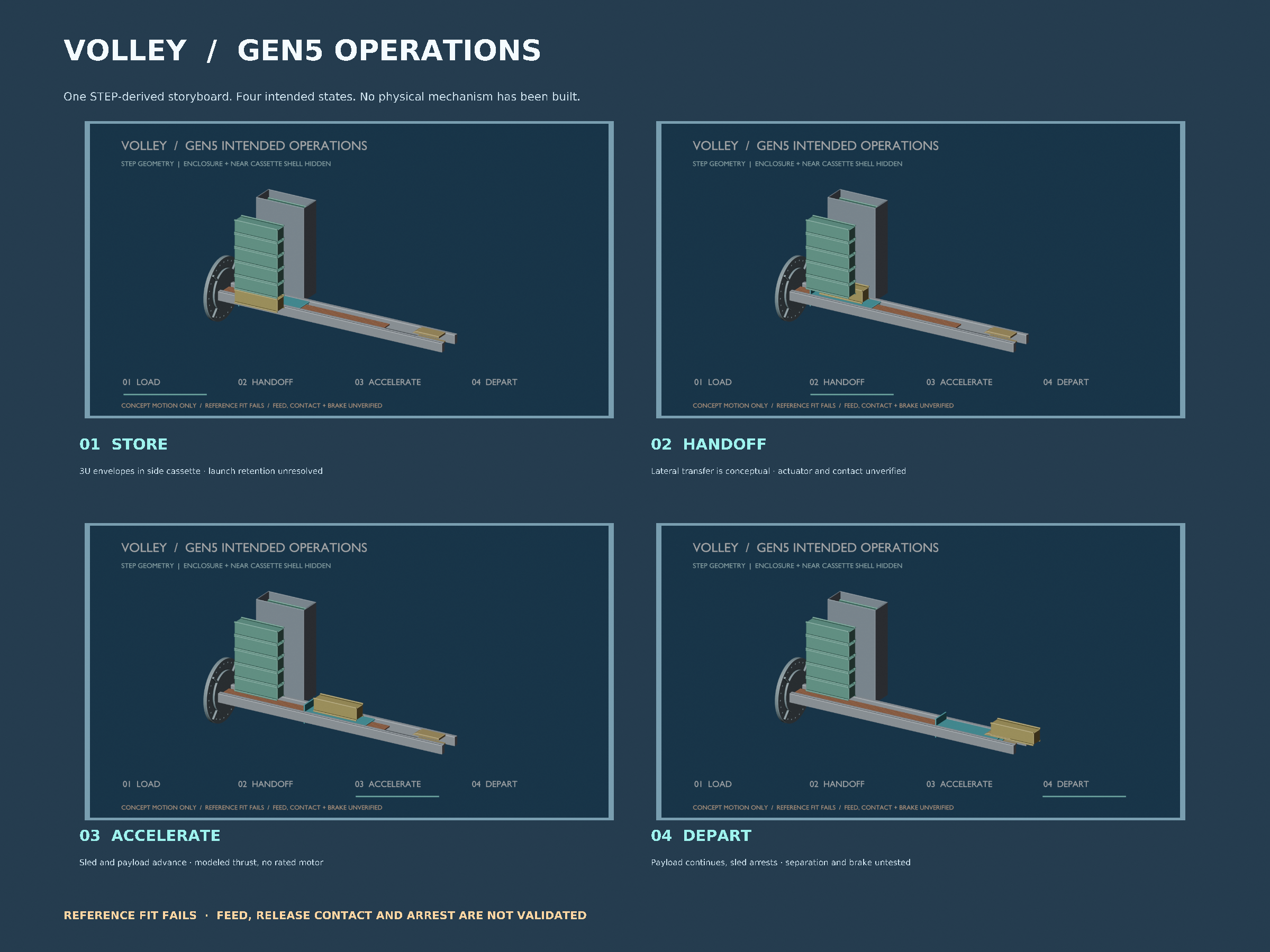
The storyboard is conceptual motion from FreeCAD-linked STEP geometry, not a mechanism test. The current Gen5 academic evaluation fails its reference fit and 3U installed-mass criteria; final freeze is open. Nothing in VOLLEY or BOLLEY has been built, measured, qualified or flown. Watch the eight-second Gen5 sequence.
| Project | What I am investigating | Useful starting point |
|---|---|---|
| VOLLEY | Can provider-hosted control of release velocity, direction and timing earn its installed mass and operating burden? | Current status |
| BOLLEY | Does a passive spacecraft interface justify its mass by letting the launcher remove the moving sled and return mechanism? | Selected winding and drive |
| GatewayCX | How should ordinary network applications survive long delays and interrupted Earth–Moon links? | Architecture and executable software evidence |
Gen5 is the controlled computational configuration for academic review. Its historical periodic model returned 16.029 m/s at 10.07 g and a 126.6 kg modeled dry mass. A finite-geometry force screen challenges that speed with an ideal-phase 12.448 m/s result; neither is a demonstrated release setting. The modeled 10.55 kg per 3U fails the installed-mass screen, and the side-fed reference STEP assembly has an 11 mm width shortfall. The final freeze remains open while these and other verification items are resolved or dispositioned.
Gen6 is future scaling research toward a 1 km/s-class objective. No mechanism, payload class or speed range is selected or validated. The independent motor-charged spring-cell bank and long gas guide remain unselected historical studies.
The mission work compares release authority with host manoeuvres and competent spring/timing alternatives. A historical two-payload screen found accepted cases under its assumptions, but the later matched twelve-shot reference does not close in any sampled case. Neither study establishes product value or a provider-approved mission.
What I want a reviewer to inspect:
- The matched mission reference: one declared host, payload and target compared across release concepts.
- The open-problem register: corrections and failed claims remain visible.
- The evidence boundary: model output, cross-checks, nominal CAD and missing measurement are kept distinct.
- The reproduction route: acceptance criteria before execution, source hashes and executable checks.
The host supplies navigation, attitude control and permitted manoeuvres. The deployer supplies a release condition. It does not provide continuing stationkeeping or collision avoidance after the spacecraft leaves.
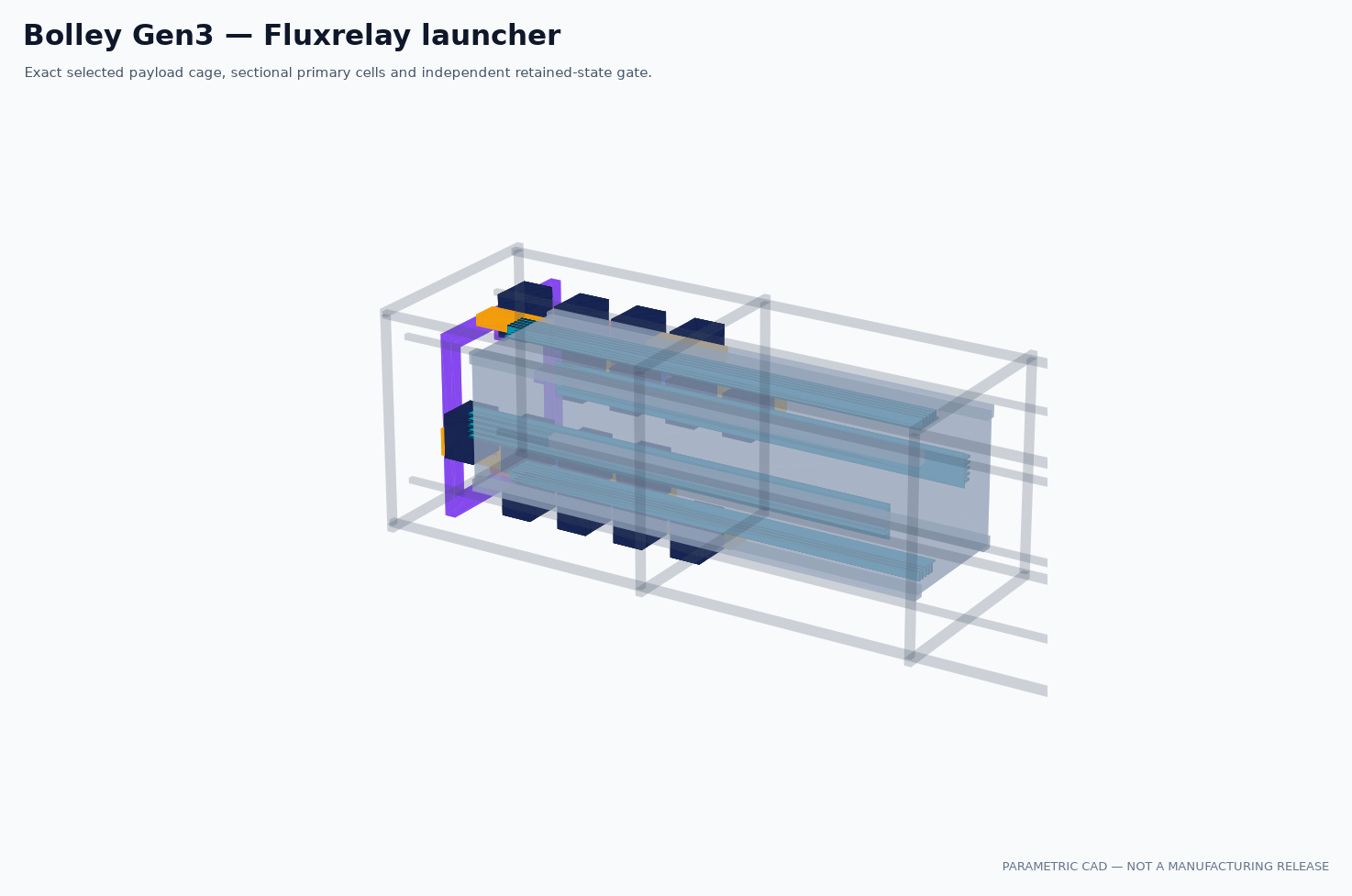
BOLLEY gives the payload a modelled 0.37136 kg passive magnetic/copper interface while retaining the powered windings and electronics on the launcher. The current 4 kg reference duty is 11.8 m/s over 0.90 m at at most 8 g nominal.
The electrical partition moved from four turns at 380 A to twelve turns at 126.667 A. The first twelve-turn fit failed its copper-volume check; the failure is preserved. The later detailed winding passes its nominal CAD bands, while field distribution, hot switching, manufacturing tolerances and installed mass still need closure.
Current BOLLEY evidence · What remains unresolved
| Repository | Reusable capability |
|---|---|
| Pulsed Linear Motor Design Lab | Force, stroke, moving-mass and source-impedance screens |
| Orbital Deployment Trade Study | Two-body release, recoil and phase-drift comparisons |
| Engineering Evidence Toolkit | Source, result, link and artifact consistency checks |
| constraint-floor | Requirement-attributed mass lower bounds |
| parametric-cad-evidence-pipeline | Parameter-to-artifact provenance and build manifests |
| spacecraft-separation-dynamics | Impulse, recoil, tip-off and internal-mass screens |
| gatewaycx-bearer-sdk | Bearer adapters and conformance checks |
| disruption-network-lab | Scheduled-contact delivery experiments |
| scientific-run-registry | Content-addressed computational runs and lineage |
These are narrow tools with explicit assumptions. Software tests and model agreement do not establish hardware performance.
I contributed to Team THRUST's payload-deployment work for the payload that placed second in the SDL Payload Challenge at IREC 2025. I work on Formula Student powertrain, motorcycle engines and ECU calibration, and run Poona Motor Club. Reverse-engineering Powertronic's map format led me to build a dual-map editor.
My engineering work uses Python for numerics and traceability, parametric CAD, field and structural solvers, and independent checks of equations and units. The skills evidence map points to the actual files.
VOLLEY-paper holds the standalone IEEE-formatted Gen5 manuscript and evidence package; it has not been submitted. VOLLEY-thesis holds the standalone college review, report, presentation and local evidence. VOLLEY-lab preserves exploratory and rejected branches.
adityavardhanmishr@gmail.com · LinkedIn · Pune, India