
English | 简体中文
High-performance C17 libraries for dynamic ordering, stable sorting, batch ordered processing and historical ordering. Full combines stable occurrence Handles, bounded local blocks and label/AVL precedence with independently owned snapshots. Choose one API family or combine them.
| Your job | Full API | What it provides |
|---|---|---|
| Edit relative positions in an editor, timeline or playlist | LksOrder |
Insert, remove, move, logical traversal and precedence; surviving Handles retain identity |
| Maintain priorities or comparator-based collections | LksManagedOrder |
Stable equal insertion, bound lookup and contextual comparison |
| Sort a pointer array once | lks_sort |
Stable ordering, copied/scratch preparation, input unchanged on OOM |
| Sort chunks and merge ordered batches | LksGroup, LksGroupBatch |
Immutable copied pointer arrays, stable equality precedence and fresh merge results |
| Save historical order and associations | LksSnapshot |
Independent bytes, sortable LS1 keys, LKS4SNP1 encoding and fresh-handle restoration |
Applications own payloads and business identities. Full supplies ordering components; a database can use them alongside its own transactions, storage and recovery. One-shot sorting is supported, with pointer-copy and scratch costs. The live-order comparisons below do not benchmark qsort or std::sort.
In the archived Windows/Linux matched live-order study, Full v4.2.0's unchanged operational implementation used 37.1% / 36.0% less elapsed time than 4.1 overall, and 80.2% / 78.1% less in compare-heavy cells. It won 45/45 cells per host against both Stable controls. Results depend on the tested workload and control.
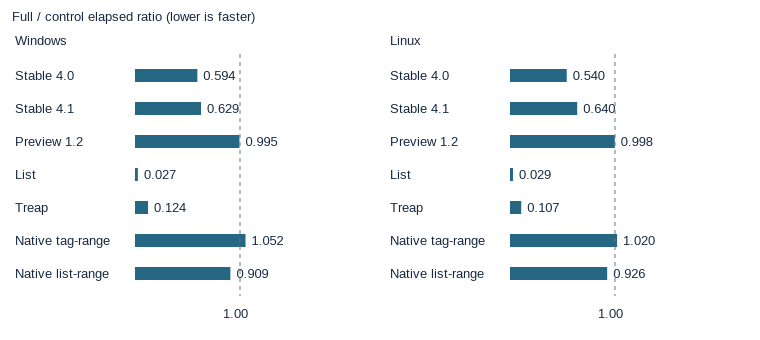
Ratios are Full/control elapsed time: the median of paired cell ratios, not throughput percentage or a ratio of unrelated medians. Each host has 45 matched cells, 1k/10k/100k initial occurrences, 20k trace operations and seven formal samples per cell/implementation. All seven controls and adverse conditions are retained in the full evidence.
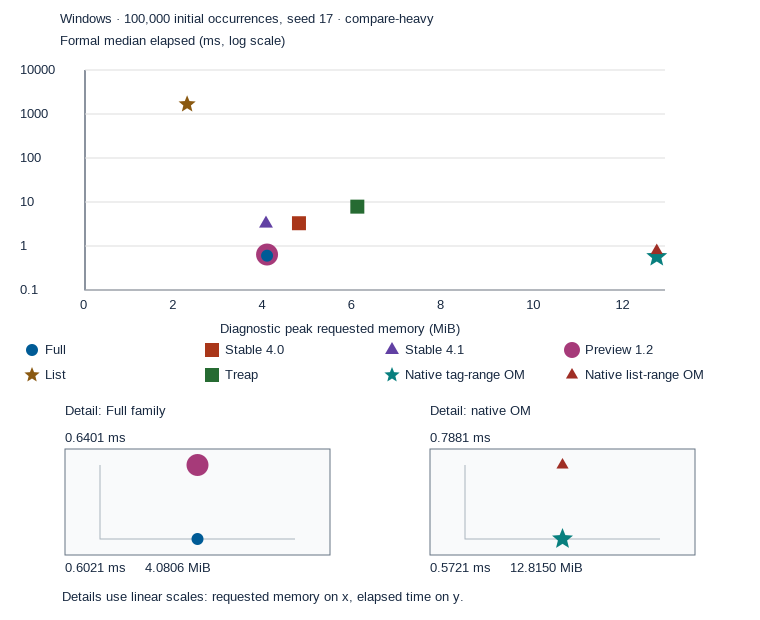
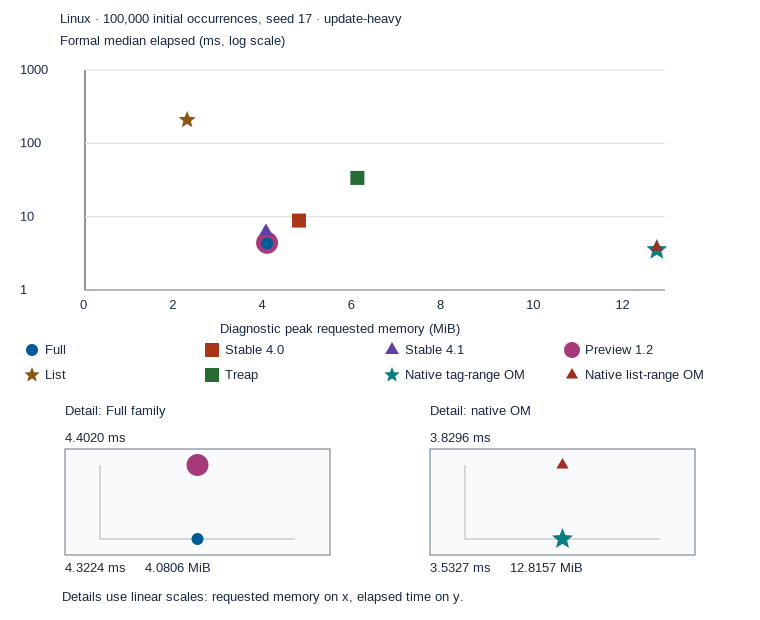
The scatter fixes 100,000 initial occurrences and seed 17. Main elapsed axis is logarithmic; linear panels show near-coincident points at their measured coordinates. Memory is separately measured diagnostic peak requested bytes, shown in MiB, rather than process RAM. In this compare-heavy example Full requested 4,278,776 bytes versus native OM 13,437,504 bytes, about 68% lower. The graph retains all eight variants.
Full/native tag-range OM overall ratios were 1.052/1.020; some update-heavy conditions favor native OM. For arbitrary relative editing with history, Full/tested Treap lifecycle wall-time ratios were 0.580/0.526 (five cells/host, incremental Treap restore). Endpoint flat history was faster: Full/flat 1.137/1.136 (13 cells/host). Bulk Treap restore is unmeasured. See selection guidance for practical tradeoffs.
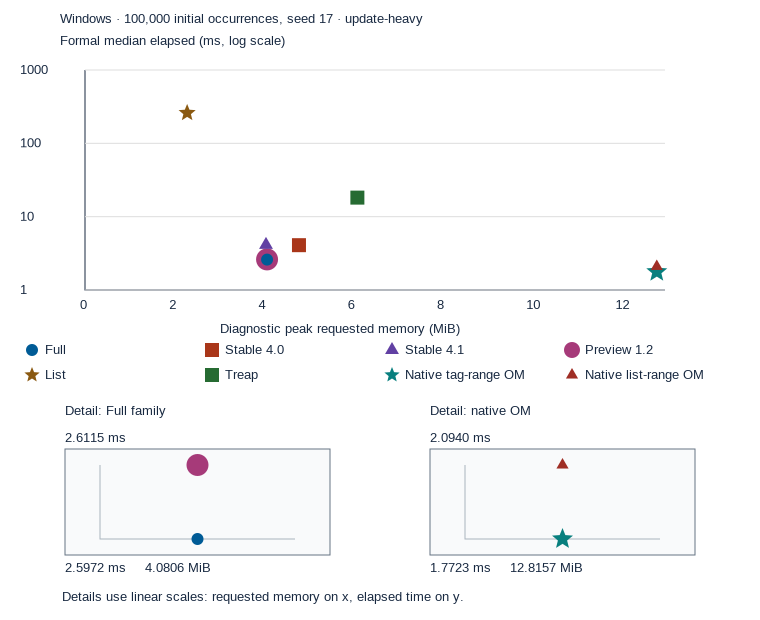
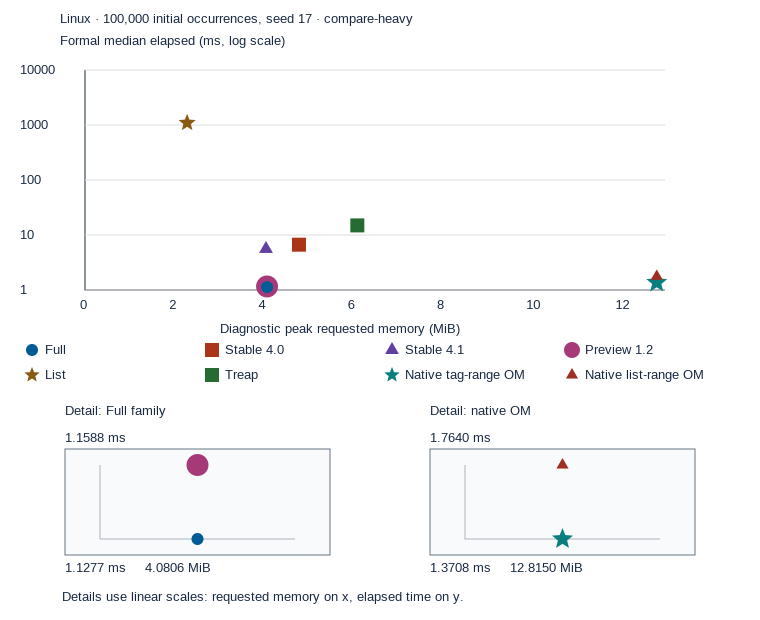
All time/memory figures: Windows compare-heavy · Windows update-heavy · Linux compare-heavy · Linux update-heavy
cmake -S . -B build -DLKS_BUILD_BENCHMARKS=ON
cmake --build build --config Debug --parallel
ctest --test-dir build -C Debug --output-on-failure
Run build/layerkeysort_example (MSVC: build/Debug/layerkeysort_example.exe). basic.c creates a container, inserts, queries, removes and destroys it. Usage includes stable sorting; seven public examples cover managed order, Groups and snapshot restore.
CMake ≥3.21: add_subdirectory, offline FetchContent or installed find_package(LayerKeySort CONFIG REQUIRED); link LayerKeySort::layerkeysort. Include only <layerkeysort.h>. The two-file distribution compiles as C17 and supports C++17 callers. Integration commands.
| Edition | Main engineering change | Compatibility and evidence |
|---|---|---|
| 4.0 | Stable occurrence Handles, bounded blocks/AVL, immutable history and batch utilities | Frozen 64 functions / 14 types, LS1 and LKS4SNP1; historical release record |
| 4.1 | Shared Block owner and compact Snapshot metadata | Source-compatible storage reduction; historical 100k–10m results and regressions in 4.1 record |
| 4.2 | Affected-slot updates, bounded labels with AVL fallback, fixed-width wire conversion | Same public/wire contracts; cumulative Windows/Linux evidence and Stable preparation record |
Download/source status: This documentation presents the prepared Full v4.2.0 Stable edition at an immutable preparation revision. Main now includes the accepted Full v4.2.0 implementation and Stable metadata; v4.2.0 is not yet tagged or published. Published Stable and repository Latest remain v4.1.0; use that working release for published assets. The planned v4.2.0 tag and assets have not been published. Stable 4.1 API remains accessible.
| Full | Mini | |
|---|---|---|
| Capabilities | Relative and comparator order, stable sort, Group/Batch, snapshots and restore | Lightweight relative edits and stable occurrence Handles |
| Representation | Bounded blocks, labels and balanced index | Independent non-intrusive doubly linked list |
| Arbitrary precedence | Label path with logarithmic AVL fallback | O(n) worst case |
| Public API | 64 functions | 18 functions |
| Build | Root CMakeLists.txt |
mini/CMakeLists.txt |
| Published release | Full 4.1.0 | Mini 1.0.0 |
Neither product links the other's production code. These are capability distinctions, not Mini performance rankings. Workbench is a Mini consumer/validation application under consumers/layer-order-workbench/. Embedded/MCU remains a future concept.
Handles represent live occurrences and expire on own removal/source destruction; they are not durable application IDs. Keep comparator semantics and all affected sorted borrowers consistent when editing shared payloads. Reinsertion can fail and remove/edit/reinsert is not transactional. Caller synchronization is required for conflicting access; callback guards and marker atomics are not container locks.
Local block/index work is bounded by private block policy plus balanced-index maintenance, with allocator/comparator costs in addition. Snapshot capture/export is O(N+A); retained histories and restore scratch consume memory. Full supplies no general binary ABI, database, transaction manager or CRDT. The complete API contracts and performance evidence describe applicability and unmeasured alternatives.
- Implementation walkthrough — execution paths across 16 production modules.
- Complete API guide — all 64 functions, lifetime, failure and concurrency.
- Internal algorithms — bounded blocks, labels, AVL, wire and stable merging.
- Validation and distribution — tests, fixtures and reproducible integration.
Architecture · Compatibility · V3 migration · Development · Changelog
Full roadmap #3 · Mini roadmap #7 · Product-line policy · Contributing · MIT license · Author’s independent project directory