
- 🔍 Deep Objects Diffing: Detects changes at any depth.
- ✂️ Compact Array Diffs: Shortest edit scripts (Myers LCS) — inserting one element into a 10k array yields 1 op, not 10,001.
- 🩹 Efficient Patching: Apply diffs to recreate target objects.
- 🧬 Type-Safe Serialization: Round-trip diffs across network/process boundaries with
serializeanddeserializepreserving all JS native types. - 🛠️ Extensible: Support for custom object types via
diffWith(). - 📦 Modern Ecosystem: Built for Bun, Node.js, Deno, and Browser.
- 🟦 TypeScript Native: Full type safety and autocompletion.
- ⚡ High Performance: Optimized for speed and minimal memory footprint.
Install @opentf/obj-diff using your preferred package manager:
# Bun
bun add @opentf/obj-diff

# pnpm
pnpm add @opentf/obj-diff

# npm
npm install @opentf/obj-diff

# Deno
deno add @opentf/obj-diffThe library natively supports the following types:
- Primitives:
Undefined,Null,Number,String,Boolean,BigInt. - Built-in Objects:
Plain Objects {},Array,Date,Map,Set,TypedArray(Uint8Array,Float32Array, etc.),ArrayBuffer,DataView. - Temporal: all
Temporaltypes (Instant,PlainDate,PlainTime,PlainDateTime,PlainYearMonth,PlainMonthDay,ZonedDateTime,Duration) — compared as immutable values (Durationstructurally by its canonical string, since it has no.equals()). - Class Instances: instances sharing the same prototype are diffed by their own enumerable properties; instances of different classes are reported as replaced.
Performs a deep comparison between two objects.
import { diff } from '@opentf/obj-diff';

const result = diff(obj1, obj2);type DiffResult = {
type: 0 | 1 | 2 | 3 | 4; // 0: Deleted, 1: Added, 2: Changed,
// 3: Inserted (array splice-in), 4: Removed (array splice-out)
path: Array<unknown>; // path to the property; Map entries use the Map key itself
value?: unknown; // the new value (for types 1, 2 and 3)
};Types 3 (INSERTED) and 4 (REMOVED) are array-only splice operations with application-time indexes — they are what make array diffs compact:
diff([1, 2, 3], [0, 1, 2, 3]);
//=> [{ type: 3, path: [0], value: 0 }]  // 1 op, not 4
The constants (DELETED, ADDED, CHANGED, INSERTED, REMOVED) are exported from the package root.
Applies an array of diff results to an object.
import { patch } from "@opentf/obj-diff";

const updatedObj = patch(originalObj, diffResults);A diff holds live values by reference, so JSON.stringify loses their types (Date→string, Map/Set→{}, BigInt→throws). Use serialize/deserialize to send a diff across a process or network boundary and patch it back into the correct types on the other side:
import { diff, patch, serialize, deserialize } from "@opentf/obj-diff";

// client
const wire = serialize(diff(a, b)); // a JSON string, type-safe

// server
const patched = patch(a, deserialize(wire)); // Date/Map/Set/… restored exactly
value stays readable — each special value becomes a reference token "@n", with the real types collected in a per-op $refs table:
{
  "type": 1,
  "path": ["user"],
  "value": { "id": 1, "lastSeen": "@1", "roles": "@2" },
  "$refs": {
    "1": { "_t": "Date", "_v": "2026-07-15T00:00:00.000Z" },
    "2": { "_t": "Set", "_v": ["admin", "editor"] }
  }
}
Every supported type is preserved (Date, RegExp, Map, Set, TypedArray, ArrayBuffer, DataView, Error, URL, BigInt, Temporal, …), nested to any depth. Circular references and objects shared by identity are rebuilt with the same identity on the far side (plain objects and arrays are hoisted into $refs when referenced more than once; single-use containers stay inline). Symbols, functions, class instances, and cycles that run through a Map/Set/Error throw. Deserializing a Temporal value requires a Temporal implementation on globalThis.
Need the same type-safe codec for any value, not just a diff? stringify/parse are the general-purpose counterpart — a drop-in, richer JSON.stringify/JSON.parse that keeps native types intact:
import { stringify, parse } from "@opentf/obj-diff";

const wire = stringify({
  when: new Date(),
  tags: new Set(["a", "b"]),
  prefs: new Map([["theme", "dark"]]),
  big: 42n,
});

const value = parse(wire); // Date / Set / Map / BigInt all restored
Same coverage as above — every native type, plus circular references and shared identity. Symbols, functions, and class instances throw.
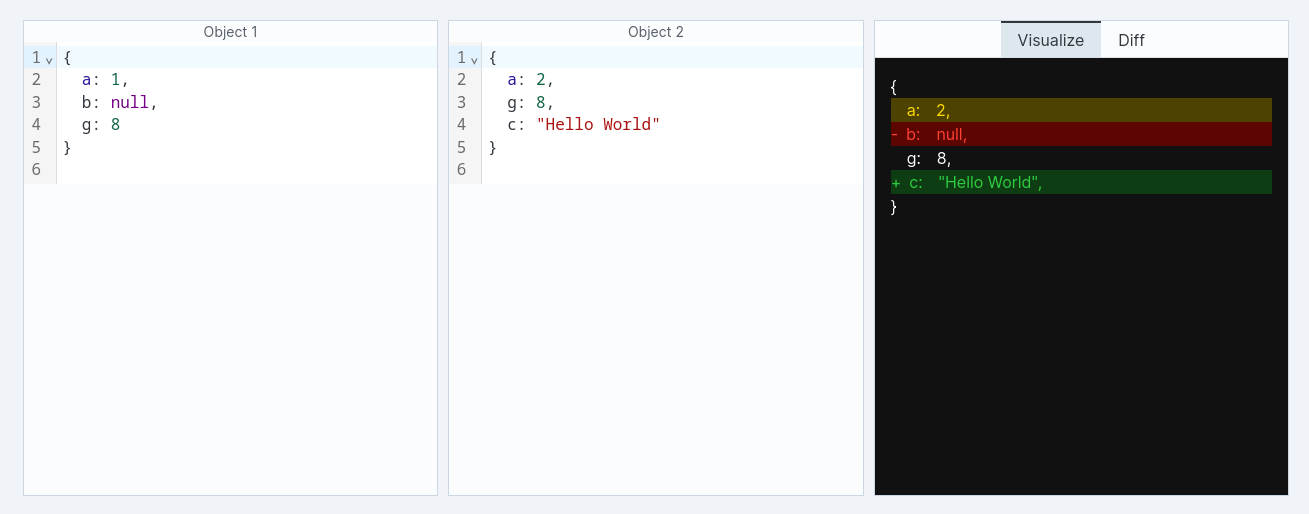
const a = { a: 1, b: 2 };
const b = { a: 2, c: 3 };

diff(a, b);
/*
[
  { type: 2, path: ["a"], value: 2 },
  { type: 0, path: ["b"] },
  { type: 1, path: ["c"], value: 3 }
]
*/const a = { foo: { bar: [1, 2] } };
const b = { foo: { bar: [1] } };
const d = diff(a, b);
const res = patch(a, d); // res is deep equal to bNatively diff and patch modern collections.
const a = new Set([1, 2]);
const b = new Set([2, 3]);

diff(a, b);
/*
[
  { type: 2, path: [0], value: 2 },
  { type: 2, path: [1], value: 3 }
]
*/Safe comparison of recursive objects without infinite loops.
const a = { id: 1 };
a.self = a;
const b = { id: 2 };
b.self = b;

diff(a, b);
// Output: [{ type: 2, path: ["id"], value: 2 }]Extend the diffing logic for specialized types like MongoDB ObjectId.
import { diffWith } from "@opentf/obj-diff";
import { ObjectId } from "bson";

const result = diffWith(record1, record2, (a, b) => {
  if (a instanceof ObjectId && b instanceof ObjectId) {
    return a.toString() !== b.toString();
  }
});For maximum performance, @opentf/obj-diff preserves internal object identity (sharing) during the patch() operation.
If your original object contains multiple paths pointing to the same object instance, patching one of those paths will affect all its aliases.
const shared = { x: 1 };
const a = { first: shared, second: shared };
const b = { first: { x: 1 }, second: { x: 2 } };

const d = diff(a, b);
const res = patch(a, d);

// res.first.x will be 2 because it shares the same instance as res.second
console.log(res.first.x); // 2
Tip
If you require independent branches after patching, ensure your input objects do not share internal references that are expected to diverge.
We have rebuilt our benchmark suite using mitata and split it into distinct categories to provide a clear, fair, and comprehensive comparison against the libraries developers actually use.
Testing how quickly libraries can detect differences between two structures.
| Scenario | @opentf/obj-diff |
microdiff |
deep-diff |
just-diff |
deep-object-diff |
|---|---|---|---|---|---|
| No changes | 1.89 µs |
1.85 µs |
1.66 µs |
2.83 µs |
4.37 µs |
| One property | 1.93 µs |
1.46 µs |
1.24 µs |
2.48 µs |
3.86 µs |
| Deep nested (9 lvls) | 1.81 µs |
1.93 µs |
3.18 µs |
4.51 µs |
3.47 µs |
| Mixed types (JS native) | 1.81 µs |
2.21 µs |
2.30 µs |
2.96 µs |
3.70 µs |
Testing the full lifecycle: Generating a diff and applying it to reconstruct the target.
| Scenario | @opentf/obj-diff |
fast-json-patch |
jsondiffpatch |
rfc6902 |
just-diff + apply |
|---|---|---|---|---|---|
| One property | 4.03 µs |
2.16 µs |
3.82 µs |
3.78 µs |
4.21 µs |
| Mixed changes | 2.90 µs |
2.24 µs |
8.46 µs |
9.49 µs |
4.33 µs |
(Note: fast-json-patch is highly optimized for strict JSON, but fails on JS-native structures like Maps/Sets/Dates. Among full-featured libraries, @opentf/obj-diff is significantly faster at patching).
Testing performance on a generated 1 Megabyte JSON payload with one deep change and one insertion.
| Metric (1MB JSON) | @opentf/obj-diff |
microdiff |
jsondiffpatch |
|---|---|---|---|
| Execution Time | 33.08 ms |
27.36 ms |
768.29 ms (Slow) |
| Diff Size (Bytes) | 130 B |
198 B |
131 B |
| Memory Allocation | ~0 MB |
6.45 MB |
~0 MB |
Testing modern JavaScript support and complex edge case handling.
| Feature | @opentf/obj-diff |
microdiff |
jsondiffpatch |
fast-json-patch |
|---|---|---|---|---|
| Date | ✅ | ✅ | ✅ | JSON only |
| Map | ✅ | ❌ | ❌ | ❌ |
| Set | ✅ | ❌ | ❌ | ❌ |
| TypedArray | ✅ | ✅ | ✅ | ❌ |
| Circular Refs | ✅ | ✅ | ✅ | ❌ |
| RegExp | ✅ | ✅ | ✅ | ❌ |
| Sparse Arrays | ✅ | ✅ | ✅ | JSON only |
Conclusion: @opentf/obj-diff offers the exactness and JS-native feature set that JSON-patch libraries lack, while remaining orders of magnitude more scalable than older, heavy libraries like jsondiffpatch.
Round-tripping real JavaScript values through a JSON boundary — the job superjson does.
| Axis | @opentf/obj-diff |
superjson |
|---|---|---|
| Type fidelity (22 native types) | 22 / 22 | 14 / 22 |
| Speed (stringify / round trip) | ~3× / ~2× faster | baseline |
| Wire size | smaller for leaf & native-heavy values | smaller when many special values cluster |
superjson silently degrades Float64Array specials (NaN/-0/∞ → 0), turns ArrayBuffer/DataView into plain objects, unwraps boxed primitives, drops an Error's own props, and throws on BigInt64Array. Full breakdown on the comparison page.
bun run benchmarks/category-a-diff.js
bun run benchmarks/category-b-patch.js
bun run benchmarks/category-c-large.js
bun run benchmarks/category-d-accuracy.js
bun benchmarks/serialization.mjs # obj-diff stringify/parse vs superjsonThe JSON Patch protocol is quite heavy and complex. We've optimized @opentf/obj-diff for performance and simplicity, which covers the vast majority of real-world use cases.
An empty path denotes the Root of the object. It typically means the entire source was replaced by the target value (e.g., comparing an object to null).
This project is licensed under the MIT License.
⚡ Powered by Open Tech Foundation