




Drop this into your GitHub profile README and stop being boring.

Most GitHub stat badges are flat. Flat bars, flat text, flat colors. They blend into every README on the planet.
CommitPulse is different.
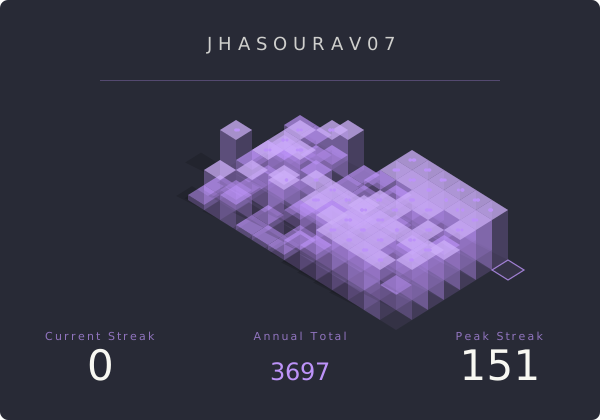
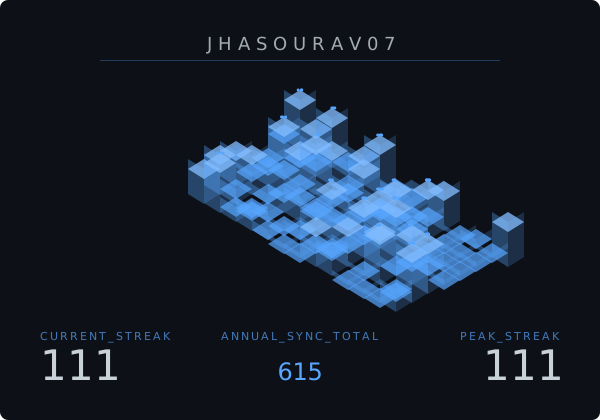
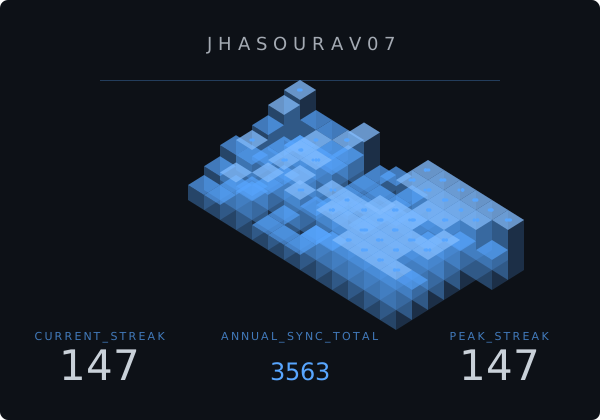
We render your contribution data as a 3D Isometric City — a grid of glowing towers where each column's height is directly proportional to your commit count that day. The more you grind, the taller your skyline grows.
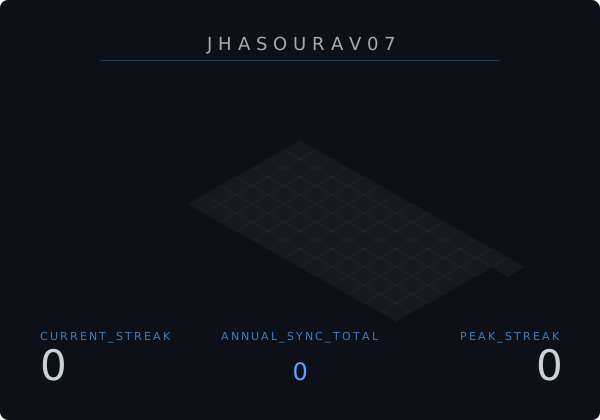
Ghost City Architecture: In this mode, zero-contribution days aren't just empty space. They are rendered as thin, wireframe-style blueprint foundations (4px high). This gives your commit landscape a structured, architectural "work-in-progress" look even during rest days, maintaining the premium 3D aesthetic across the entire calendar.
This is not decoration. This is a live, animated data visualization that makes your dedication impossible to ignore.
| Property | Flat Badges | CommitPulse Monolith |
|---|---|---|
| Visual Depth | None | Full isometric 3D perspective |
| Data Density | 3 numbers | 98-day contribution landscape |
| Animation | Static | Radar scan line, glow effects & live pulsing indicator for today's commits |
| Personality | Generic | Uniquely yours, every day |
| Impression | "They have stats" | "They ship code like a machine" |
The design philosophy is simple: your commit history deserves a monument, not a meter.
Paste into any Markdown file — GitHub README, Notion, or your portfolio:
<!-- Default (Dark theme) -->

<!-- Neon theme -->

<!-- Custom colors -->
CommitPulse is designed to be fully composable. Every visual attribute is controllable via a URL parameter, following a clear priority chain:
URL Parameter > Theme Default > System Fallback
| Parameter | Type | Required | Default | Description |
|---|---|---|---|---|
user |
string |
✅ Yes | — | GitHub username to render |
theme |
string |
No | dark |
Preset theme name (see below) |
bg |
hex |
No | Theme default | Background color — without # |
accent |
hex |
No | Theme default | Tower & glow color — without # |
text |
hex |
No | Theme default | Label & stat text color — without # |
radius |
number |
No | 8 |
Border corner radius in pixels |
speed |
string |
No | 8s |
Radar scan animation duration (e.g. 4s, 12s) |
scale |
string |
No | linear |
Tower height scaling: linear or log (logarithmic) |
font |
string |
No | CommitPulse default typography | Any Google Font name (e.g., Orbitron, Inter) |
refresh |
boolean |
No | false |
Bypass cache for real-time data |
year |
string |
No | — | Calendar year to render (e.g. 2023, 2024) |
| Theme | Preview | bg |
accent |
text |
|---|---|---|---|---|
auto |
System light / dark | adapts | adapts | adapts |
dark (default) |
GitHub dark | 0d1117 |
58a6ff |
c9d1d9 |
neon |
Cyberpunk | 000000 |
ff00ff |
00ffcc |
dracula |
Dracula Pro | 282a36 |
bd93f9 |
f8f8f2 |
github |
GitHub green | 0d1117 |
238636 |
ffffff |
light |
Clean & minimal | ffffff |
0969da |
24292f |
random |
Surprise theme on reload | varies | varies | varies |
autouses CSS@media (prefers-color-scheme)inside the SVG so the badge switches between thelightanddarkpalettes based on the viewer's OS setting — no JavaScript required. This is ideal for GitHub profile READMEs where visitors may use either mode.
<!-- Auto theme — adapts to the viewer's light/dark system preference -->
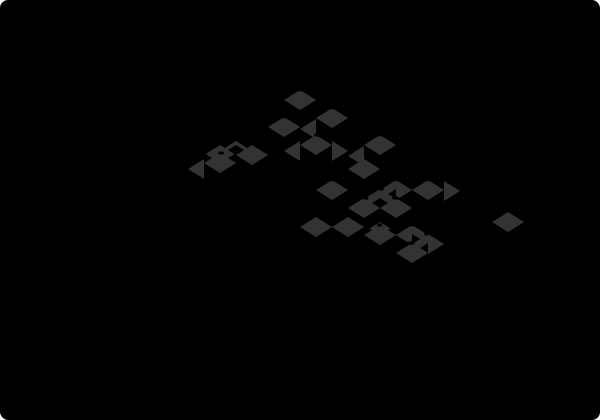
<!-- The Dracula aesthetic -->
<!-- Dynamic Google Fonts — Space-age look with Orbitron -->
<!-- Fully custom — hot orange on void black -->

<!-- Force bypass cache for latest data -->
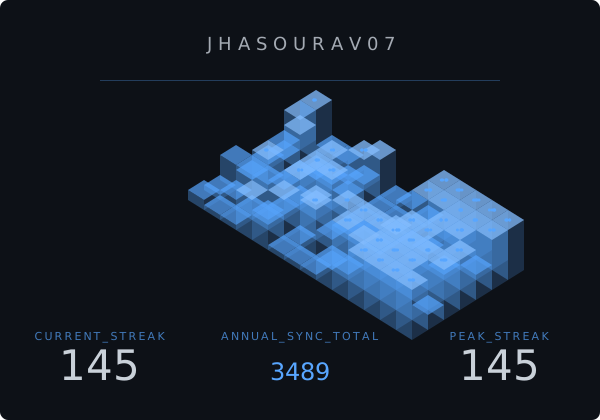
<!-- Fast scan + logarithmic scaling for power users -->
<!-- View contributions for a specific past year -->
GitHub's contribution graph can return different totals depending on when and how you query it. We solved this at the infrastructure level.
The GitHub GraphQL API calculates totalContributions and daily contribution windows using UTC-based ISO 8601 timestamps. A naive implementation that queries at any arbitrary time — without anchoring to UTC midnight boundaries — will produce counts that are inconsistent between requests. This is the root cause of the classic "my card shows 378 but GitHub shows 385" discrepancy.
CommitPulse uses a two-part fix:
1. Cache invalidation anchored to UTC midnight (utils/time.ts)
export function getSecondsUntilUTCMidnight(): number {
  const now = new Date();
  const midnight = new Date(
    Date.UTC(now.getUTCFullYear(), now.getUTCMonth(), now.getUTCDate() + 1, 0, 0, 0)
  );
  return Math.floor((midnight.getTime() - now.getTime()) / 1000);
}
The CDN cache TTL is set to expire at exactly the next UTC midnight, not at some fixed-interval offset. This guarantees that when GitHub's contribution window rolls over, our cache does too — simultaneously.
2. No internal fetch caching (lib/github.ts)
const res = await fetch(GITHUB_API_URL, {
  cache: 'no-store', // Bypass Next.js's internal fetch cache
});
Caching is handled entirely at the HTTP response layer (Cache-Control: s-maxage), giving us surgical control over what gets cached and for how long — without stale data poisoning the GraphQL response.
Result: CommitPulse's contribution counts are always in sync with GitHub's actual UTC day boundaries.
app/api/streak/route.ts       →  Next.js 16 Edge-compatible API Route
app/api/track-user/route.ts   →  User tracking API — records GitHub usernames to MongoDB
lib/github.ts                 →  GitHub GraphQL API client
lib/calculate.ts              →  Streak algorithm (current + longest + grace period)
lib/mongodb.ts                →  Cached MongoDB connection utility (serverless-safe)
lib/svg/generator.ts          →  3D Isometric SVG renderer + CSS animations
lib/svg/themes.ts             →  Prebuilt theme palette system
models/User.ts                →  Mongoose User schema
utils/time.ts                 →  UTC midnight synchronization utilities
types/index.ts                →  TypeScript interfaces (StreakStats, BadgeParams, BadgeTheme)
| Layer | Technology | Purpose |
|---|---|---|
| Framework | Next.js 16 (App Router) | API routes, edge deployment |
| Language | TypeScript 5 | Type-safe parameters and interfaces |
| Data Source | GitHub GraphQL API v4 | contributionsCollection query |
| Database | MongoDB + Mongoose | Tracks GitHub usernames of users who generate a monolith |
| Rendering | Pure SVG + SVG Filters | <feGaussianBlur> for the glow effect |
| Animation | SVG <animate> |
Radar scan line + current-day block pulsing, no external libraries |
| Typography | Google Fonts (Syncopate + Space Grotesk) | Loaded inline via @import |
| Deployment | Vercel Edge Network | Auto-scaling, global CDN |
| Caching | Cache-Control: s-maxage |
UTC-midnight-synced cache invalidation |
# 1. Clone the repository
git clone https://github.com/JhaSourav07/commitpulse.git && cd commitpulse

# 2. Install dependencies
npm install

# 3. Create your environment file
cat > .env.local << 'EOF'
GITHUB_TOKEN=your_github_pat_here

# Optional — enables user tracking (see below)
# MONGODB_URI=mongodb+srv://...
EOF

# 4. Start the development server
npm run dev
📌 Token Scope: Your GitHub Personal Access Token needs the
read:userscope only. No write permissions required.
Then visit: http://localhost:3000/api/streak?user=YOUR_USERNAME
CommitPulse records the GitHub username of everyone who generates a monolith from the landing page into a MongoDB collection. This is entirely optional for local development — the app works perfectly without it.
If MONGODB_URI is not set, the /api/track-user endpoint will log a warning and skip the database write gracefully:
WARN: MONGODB_URI is not set. Bypassing user tracking for local development.
To enable tracking locally, add your connection string to .env.local:
MONGODB_URI=mongodb+srv://<user>:<password>@cluster.mongodb.net/commitpulseFor production (Vercel), add MONGODB_URI to your project's Environment Variables settings.
Set the GITHUB_PAT environment variable in your Vercel project settings, and you're live.
CommitPulse features a fully custom, GitHub Actions-powered Issue Management System designed for large open-source events like GSSoC.
We built an anti-hoarding, self-service automation layer right into the repository:
- Self-Claiming: Contributors can grab issues instantly by commenting
/claim. - Fair Play: A strict one-active-issue-per-contributor rule prevents issue hoarding.
- Stale Expiry: A scheduled chron job automatically unassigns inactive contributors after 3 days.
- Self-Service Labels: Anyone can tag issues using
/addlabel <tag>.
This ensures maintainers aren't bottlenecks and the community moves incredibly fast.
CommitPulse is an open project built for the Web3 and open-source community. Whether you want to design a new theme, refine the isometric geometry, or improve timezone edge cases — you are welcome here.
Read the full guide: CONTRIBUTING.md
MIT © Sourav Jha
Browse theme previews here: Theme Gallery
Built with obsession, shipped with precision.
⭐ If CommitPulse made your profile look elite, drop a star. ⭐
Thanks to all contributors who have helped make CommitPulse better!