Simple artificial life python program based on this slime simulation paper, using compute shaders to run the simulation.
"Characteristics of Pattern Formation and Evolution in Approximations of Physarum Transport Networks"

{
    "width" :           930,
    "height":           540,
    "agent_count":      10000,
    "steps_per_frame":  1,
    "spawn_mode":       1,
    "agent_overlapping":true,
    "radial_boundary":  false,
    "border":           0,
    "decay_rate":       0.01,
    "blur_rate":        0.2,
    "species": [
        [ 22.5, 45, 9, 1, 1, [1, 1, 1] ]
    ]
}agent_count: The amount of agents to run in the simulationsteps_per_frame: The amount of updates to run per frame (fps auto-capped at 60)spawn_mode: How the agents spawn when starting the simulation
0: Random position and angle
1: All at the center with a random angle
2: Random point in a circle with random angle
3: Random point in a circle with angle towards the center
4: Random point in a circle rim with angle towards the centeragent_overlapping: When false, agents cannot move to a cell where another agent already isradial_boundary: Sets the agents boundary to a circle(height/2)border: Border boundary offsetdecay_rate: How much to decay the agent trails per frameblur_rate: How much to blur the agent trails per framespecies: Array containing all the spieces to simulate.(max 4)
[0] SA: FL and FR sensor angle from forward position.deg
[1] RA: Agent rotation angle.deg
[2] SO: Sensor offset distance.px
[4] SS: Step size, how far agent moves per step.px
[3] SW: Sensor width.px
[5] Color: The color of the species inRGB 0-1 or 0-255.
a5.json
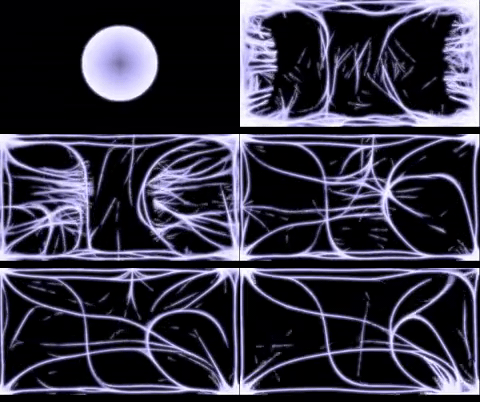
a2.json
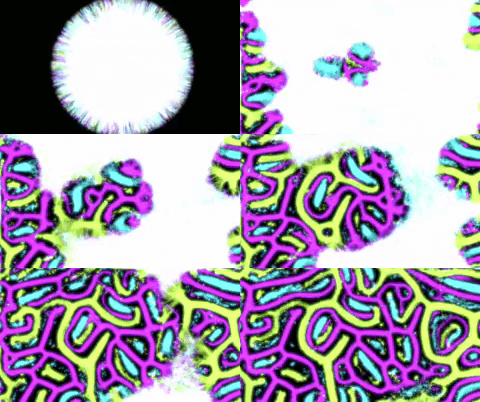
a6.json
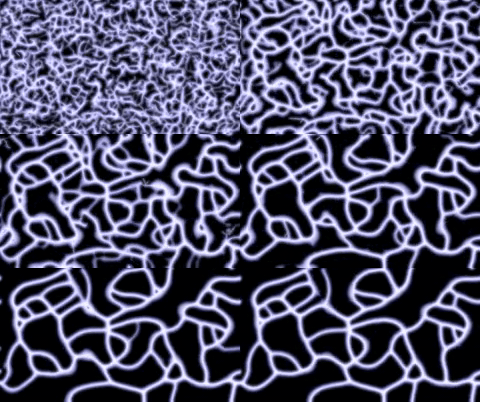
food.json, 200 agents find the shortest path between two food sources. (sped up by 300x)
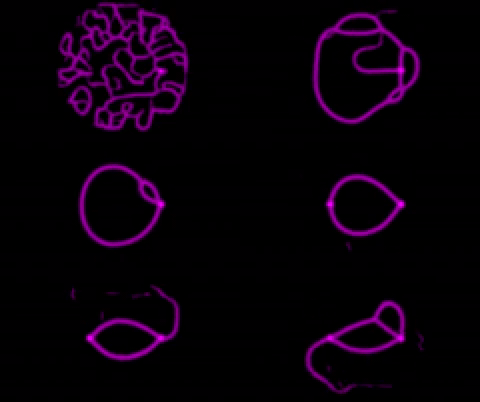
Used compushady to run the HLSL compute shaders.